
I Feel Alone in My Eating Disorder
The Silent Room: Why Eating Disorders Make Us Feel So Deeply Alone
You are sitting in a room full of people who love you. There is music playing, the clinking of silverware, and the warm hum of laughter. Yet, you might as well be standing on a deserted island, shivering in the dark. Inside your head, a deafening monologue is playing. It calculates the calories on your plate, measures the space between your thighs against the chair, and whispers that you do not belong here.
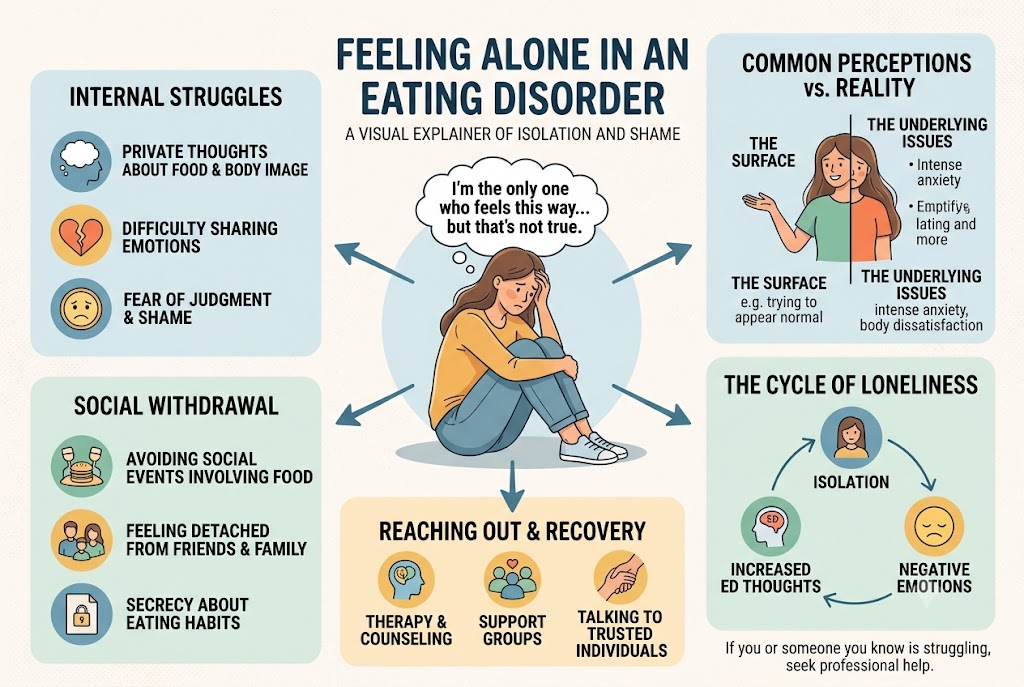
If you have ever thought, “I feel alone in my eating disorder,” please know this: that loneliness is not a byproduct of your illness. It is the illness itself.
Eating disorders—whether anorexia, bulimia, binge eating disorder (BED), ARFID, or OSFED—are incredibly clever. They survive by convincing you that they are your only true friend, your safest protector, and your deepest secret. But this protection is a cage. To heal, we must first understand why this isolation feels so absolute, and how we can begin to dismantle the walls, one brick at a time.
“An eating disorder is the only disease that convinces you that you are safer in its grip than in the arms of those who love you.”—
The Psychology of Isolation: Why the Illness Demands Secrecy
To understand why you feel so profoundly isolated, we have to look at how eating disorders function psychologically. They thrive in the shadows. The moment you bring your struggles into the light, the disorder loses its power over you. To protect itself, the eating disorder deploys several defense mechanisms that cut you off from the world:
1. The Shame-Secrecy Cycle
Whether it is the ritual of purging, the intense distress of a binge, or the strict rules of restriction, eating disorder behaviors are often accompanied by immense shame. You worry that if people knew what was happening inside your mind, they would judge you, pity you, or try to control you. To avoid this, you withdraw. You decline dinner invitations, make excuses to avoid social gatherings, and slowly shrink your social circle until it is just you and the disorder.
2. The “Deafening Voice” of the Eating Disorder
When you are struggling, your brain chemistry is altered. Nutrition deprivation or chaotic eating patterns affect the prefrontal cortex—the area of the brain responsible for decision-making and social connection. The internal commentary becomes so loud that it drowns out external reality. You can’t focus on what your friend is saying because you are too busy obsessing over how to compensate for the meal you just ate.
3. The Illusion of Uniqueness
The disorder whispers a dangerous lie: “Nobody understands. Your pain is too weird, too disgusting, or too insignificant for anyone else to care about.” This illusion of uniqueness keeps you trapped, making you believe that you are the only person on earth experiencing this specific brand of torment.
—Dismantling the Wall: How to Reach Out When You Feel Paralyzed
Recognizing the loneliness is the first step. The second, and arguably hardest, step is reaching across the void. When you have spent months or years hiding, reaching out feels like standing on the edge of a cliff. Here are practical, low-barrier ways to start reconnecting without overwhelming your nervous system.
Step 1: Write It Down Before You Say It
When we try to speak about our eating disorders, our throats often close up. The shame locks our jaws. If speaking feels too difficult, use the power of the written word.
- Write a letter or an email to a trusted friend or family member.
- Send a simple text message: “I’m going through a really hard time with my relationship with food and my body right now. I’m not ready to talk about all of it, but I just need you to know I’m struggling.”
- Keep a journal of your feelings to help clarify what you want to communicate when you are ready.
Step 2: Find “Low-Stakes” Connection
You don’t have to jump straight into deep, emotional conversations. Sometimes, just being in the presence of others without talking about your illness is healing. Try to engage in activities where food is not the central focus:
- Go to a movie where you can sit side-by-side with a friend in comfortable silence.
- Join an art class, a book club, or a pottery workshop.
- Take a walk in nature with someone you trust, focusing on the sights and sounds around you.
Step 3: Leverage the Power of Virtual Communities
If speaking to people in your immediate life feels too risky right now, the internet can be a beautiful bridge. However, you must curate your digital space with extreme care. Stay away from forums that promote comparison or “tips.” Instead, look for:
- Peer support groups: Organizations like ANAD (National Association of Anorexia Nervosa and Associated Disorders) offer free, virtual, clinician-led support groups where you can talk to others who truly get it.
- Recovery-focused podcasts: Listening to therapists and individuals in recovery talk openly about their journeys can make you feel heard and validated without requiring you to speak.
- Positive social media feeds: Unfollow any accounts that trigger body dissatisfaction, and follow anti-diet dietitians, eating disorder therapists, and body-neutral creators.
For the Loved Ones: How to Reach Someone Locked Inside an Eating Disorder
If you are reading this article because you suspect someone you love is suffering in silence, your role is crucial. When someone has an eating disorder, they may push you away. They might become irritable, secretive, or defensive. It is vital to remember that this is the illness talking, not the person you love.
Here is how you can gently show them they are not alone:
Avoid Food and Weight Talk
Do not comment on their appearance, even if you think it is a compliment (e.g., “You look so healthy!”). To an eating disorder, “healthy” is often interpreted as “you’ve gained weight.” Instead, focus on their internal state. Try saying: “I’ve noticed you seem really stressed and quiet lately. I miss you, and I’m here if you want to talk about anything at all.”
Offer “Non-Food” Support
Take the pressure off. Plan hangouts that don’t involve restaurants or cooking. Suggest a movie night, a puzzle evening, or crafting. Let them know that their presence is valued, regardless of what, how, or if they are eating.
Be a Sturdy Anchor
Understand that recovery is not a straight line. There will be relapses, outbursts, and bad days. Your consistency is their lifeline. Keep showing up, keep inviting them, and keep reminding them that your love is unconditional and not tied to their recovery progress.
—The Truth About Recovery: You Do Not Have to Walk Alone
The transition from the deep isolation of an eating disorder to the vulnerability of recovery is terrifying. It requires you to give up your coping mechanism—however destructive it may be—and trust that the world will catch you when you fall.
But here is the absolute truth: You are not uniquely broken. The thoughts you are having are the exact same thoughts shared by thousands of others who are walking this path right alongside you. There is a whole community of recovery warriors, therapists, dietitians, and allies waiting to welcome you with open arms.
If you are ready to take a step toward the light, professional help is the most powerful tool you can seek. Working with an eating disorder specialist can help you untangle the complex web of emotions, trauma, and biology that keeps you trapped.
You have spent so long carrying this heavy weight by yourself. It is okay to be tired. It is okay to lay it down. You don’t have to do this alone anymore.
If you or someone you know is struggling with an eating disorder, please reach out for support. You can contact the National Eating Disorders Association (NEDA) or your country’s local mental health helpline to find resources, support groups, and professional care near you.
Dr. Lall Psychology & MindCare Services
Promotional Video : https://www.youtube.com/watch?v=T8OQ2YwKoe0
Quantum Psychology Experiential Program
Admission Form Available at : https://www.amazonauthor.in
YouTube Subscribe : https://www.youtube.com/@drlallpsychology
Linkedin Connect : https://www.linkedin.com/in/drlallpsychology
Linkedin Follow : https://www.linkedin.com/company/drlallpsychology
WhatsApp Channel : https://whatsapp.com/channel/0029VbDEEVb4o7qRCY6UEp38
To Buy Books – by – Dr. Solomon Lall 3-PhDs : Author, Mind Research Scientist, Grahastya YogRishi, Sr. Consultant : Emotional Health & Mental Wellness.
Most Popular, Acclaimed and Renowned Published Book, Now on Amazon book Stores throughout the world
Author Page : https://www.amazon.com/author/drlall
1) https://a.co/d/09tTuF6s : Quantum Psychology: Freedom from Painful Mind Matters
2) https://a.co/d/045dAL7q : Mental Hygiene is The New Dental Hygiene: The Science & Art of Keeping your Mind Clean
3) https://a.co/d/02a2WXGT : Menopause – The Mindful Pause: Redefining Menopause Through Mental Hygiene, Science, and Self-Discovery
4) https://a.co/d/01s1ae3A : Sanātan Psychology: The Science & Wisdom of Ancient Bhārata
5) https://a.co/d/0j3WmYTP : Quantum Biology: Healing the Mind With Secret Science
6) https://a.co/d/0dOByGYF : 1-3 : Quantum BioHack: The Secrets of Energy, Vibrations, Frequency & The Rhythmic Healing
7) https://a.co/d/0cPAiaQg : 2-3 : Quantum BioHack: The Secrets of Energy, Vibrations, Frequency & The Rhythmic Healing
8) https://a.co/d/0dnGlHR3 : 3-3 : Quantum BioHack: The Secrets of Energy, Vibrations, Frequency & The Rhythmic Healing
9) https://a.co/d/02XShiQh : Wired For JOY: A science-backed, heart-centered exploration of your happy hormones
10) https://a.co/d/05uD1fnf : Grahastya Yoga: The Supreme Yoga for Everyone
11) https://a.co/d/0eZn6yPF : Quantum Parenting: Parenting in the AI Age
12) https://a.co/d/03ybLa0Q : The CODD Problem : Cortisol Overload and Dopamine Deficiency.
13) https://a.co/d/00WOJjAr : Where is Your Mind Located: The Bhoot Blueprint
14) https://a.co/d/0hS1J6xK : Beyond Maya: Awakening the Mind’s Secret Science
For School & University Mental Wellness Partnerships :
For Schools – Download Flyer – (Very Popular) : https://drive.google.com/file/d/1qJ8uoDlHK7Pr0iXmID5oMFv-DkxbzV0H
For Campus – Campus Influencer Program –
https://drive.google.com/file/d/1UBFaSfoGQGBOg86G0uIgr4SUigg3n0pF
send Your Resume to mindlabs@authordrlall.com
To Check all Ongoing Job Opportunities. Study the Job Descriptions from our Associates Linked Posts :
: Social Media Content Creator – All over India. : https://www.linkedin.com/jobs/view/4435409715/
: University, School & Campus Influencer – All over India : https://www.linkedin.com/jobs/view/4433157584/
: Associate Psychologist – All over India.
https://www.linkedin.com/jobs/view/4436464924
Dr. Solomon Lall Psychology & MindCare Services is a premier emotional health and mental wellness practice delivering trusted, evidence-based psychological care. Led by Dr. Solomon Lall (23+ years experience, 2,500+ clients, 12,500+ therapy hours), the practice blends ancient Vedic mental body yogic concepts with modern mind sciences.
We provide holistic, tailored online services worldwide using a proprietary Quantum Psychology Blueprint and Quantum Biohack Framework. Specialized programs address emotional discovery, recovery, loneliness, pain, and age-specific mental health needs for individuals and corporates.
https://drlallpsychology.com
https://drsolomonlall.com
https://lalldr.com
https://whereismytherapy.com
https://leadpsychologist.com