In many classrooms across India, the promise of “mental health in schools” has begun to sound like a bureaucratic formula: appoint more counsellors, add more teams, run more visits, track more complaints, conduct more check-ins. It looks responsible. It even looks compassionate.
But responsibility without a working framework is only paperwork with good intentions.
And right now—especially in the kind of scenario described by the Times of India report on Tamil Nadu schools—our mental-health interventions are stalled not because the need is imaginary, but because the intervention logic is incomplete. The model assumes that if we increase human resources (more counsellors, more teams), the system will automatically translate into transformation at the ground level. Yet the ground reality is messier: policies remain “on paper,” orders take months, tracking becomes irregular, accountability weakens, and existing mechanisms lose seriousness. Meanwhile, students continue living inside the daily emotional pressure-cooker of school life—social, academic, familial, identity-based, and developmental.
This is why, under Dr. Solomon Lall’s Psychology framework, the question is not merely “How many counsellors do we appoint?” The question is deeper:
What exactly is “mental health” we are trying to fix in a school child—and what mechanism will genuinely influence it?
If our mental-health definition is borrowed from hospital thinking, then we will build school programmes that behave like hospital operations. And if the school system is forced to “function as a clinic,” it will fail—not because teachers are uncaring, but because the logic is wrong.
Dr. Lall’s framework doesn’t treat “mental health” as a diagnosis pipeline. It treats it as a human mind ecosystem problem: the mind’s basic functions—thoughts, imagination, feelings, emotions—need to be guided so that inner life develops into emotional balance rather than emotional collapse. Counselling is necessary when disturbance has already taken shape. But the prevention and cultivation must begin earlier, at the level of mind-formation—inside the education environment itself.
What follows is a persuasive case—grounded in the reality of the “more counsellor” approach described in the article—that this approach will have no major impact in the current scenario, not because intervention is wrong, but because the system is still trying to fix mental life with the wrong tool, at the wrong level, through the wrong pathway.
—
The scenario already reveals the core failure: policies stay “on paper,” and appointment logic arrives too late
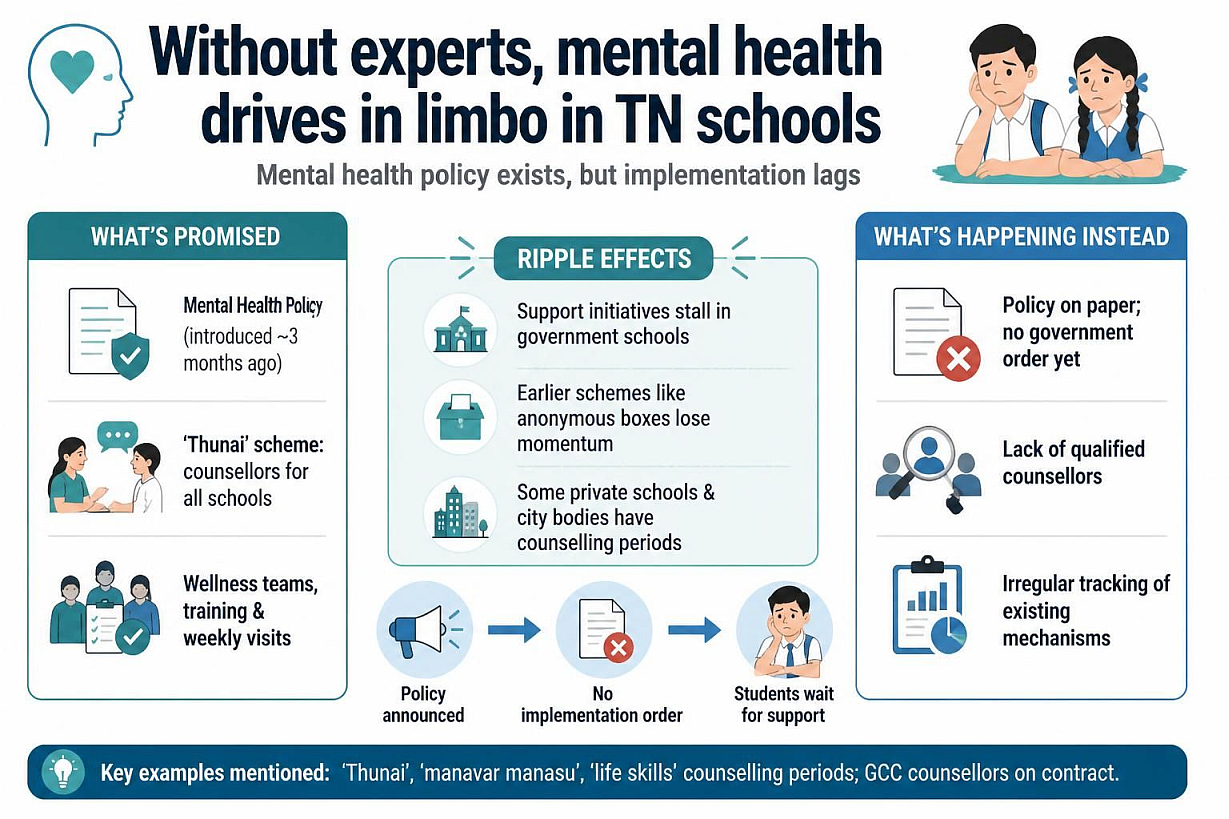
The Times of India report is explicit: Tamil Nadu introduced a Mental Health Policy for Educational Institutions three months earlier, but it “remained only on paper.” The proposed Thunai scheme —meant to appoint counsellors to all schools—had not even produced a government order yet after three months.
Now, imagine what that means in school life.
A school term is not an abstract timeline. Students live in months of progression: friendships build and break, fear of failure accumulates, exam pressure rises, behavioral conflict spreads, bullying circulates in micro-forms, and quiet distress grows into something that later appears “sudden” only because we noticed late. If a mental-wellness policy waits for delayed orders, delayed staffing, and delayed operationalization, it will miss the very windows where school-level intervention must happen.
So the first reason the “appoint more counsellors” plan fails is not ideological—it is logistical:
1. The policy mechanism doesn’t become real quickly enough to influence real student experiences.
2. Counsellor appointment becomes a delayed event, while emotional development is ongoing.
Counsellors arriving after the damage begins is like installing smoke detectors after the building has already caught fire.
—
A second failure appears immediately: counsellors are proposed, but the ecosystem around them never launches
The article doesn’t only say that counsellors were not appointed. It says that even the broader scheme components—training of adults, wellness teams led by principals, weekly counsellor visits to identify students in distress—were not implemented.
That matters because Dr. Lall’s approach does not reduce mental wellness to one role. It requires an environment that shapes how mind functions are handled day after day. When the model is built around counselling visits alone, the system becomes dependent on human availability. When the system is built around mind-environment design, it becomes resilient even when staffing is imperfect.
So in the “more counsellors” approach, the system assumes:
– If counsellors exist, they will fix what schools cannot.
But the report indicates the opposite:
– If counsellors exist on paper, nothing changes.
And if counsellors do not arrive quickly, then the “wellness ecosystem” remains incomplete.
This produces a second reason for failure:
1. Even when policies mention counsellors, the programme architecture (training, teams, routine operations, monitoring rhythm) is not activated.
2. Without ecosystem activation, “more people” cannot create “more practice.”
Counsellors without a functional mind-guiding school system become like consultants standing outside a workshop that never opened.
—
A third reason: tracking mechanisms lose seriousness once problems are solved at the school level—meaning early signals never reach system-level action
The report gives another painful pattern: mechanisms such as “Manavar Manasu” anonymous complaint boxes** were initially treated seriously, with district-level monitoring. Over time, seriousness waned. The report states that now problems are resolved at the school level and no one updates. Inspections of extra-curricular classes don’t take place.
This reveals something crucial: in the existing system, mental wellness tends to be treated as a periodic activity, not a continuous process of mind-formation.
Dr. Lall’s framework would never treat emotional balance as something you only “check” after a complaint appears. Emotional disturbance doesn’t always begin as a complaint. It begins as a shift in thoughts, imagination, feelings, and emotions—how a child interprets events, how they internalize teacher attitudes, how they form self-belief or self-doubt, how fear becomes habit.
But the “more counsellors” narrative pushes attention toward:
– complaint handling,
– distress detection,
– one-on-one counselling.
Those are necessary later steps. They cannot replace the earlier step: **school should cultivate mind functioning continuously**.
Therefore, here is the third reason counsellor appointment will not have major impact “in the current scenario”:
1. The system’s monitoring rhythm is unstable.
2. Early signals are not consistently escalated or translated into mind-environment change.
3. Once school-level problems are “resolved,” the system stops learning and stops improving.
Even if more counsellors are appointed, if the system is not trained to convert the signals it receives into ongoing mind-environment reform, counsellors become temporary responders rather than drivers of emotional development.
—
A fourth reason: counsellor-based models often become substitute policies—labels for reform rather than engines of transformation
The Times of India report mentions that the scheme was dropped for now and unlikely to figure in upcoming budget. That tells us something about how policy translates into resources: it is vulnerable to budget reprioritization and administrative re-routing.
But Dr. Lall’s framework warns implicitly against this style of reform. When mental wellness is defined as something that happens mainly through specialists, then it becomes budget-dependent and role-dependent. It can be delayed, reduced, or removed. It will never become truly embedded in education.
The deeper failure is conceptual: the intervention remains an “add-on.”
In contrast, Dr. Lall’s approach suggests mental wellness should be treated as a core dimension of education—specifically, education that understands the mind as the central internal organ and designs a school ecosystem that supports its healthy functioning.
So the fourth reason is:
1. Counsellor appointment can be cancelled or weakened without collapsing the education system—meaning it lacks structural centrality.
2. If mental wellness is not embedded in the education methodology, it will never reliably scale across India.
When mental wellness remains an add-on, it cannot withstand administrative friction.
—
Why the “physical health” analogy breaks in mental wellness
In physical health system, we assume health problems are diagnosable, treatable, and often tied to specific physical pathology. So the hospital logic can map (imperfectly, but at least functionally) onto screening + diagnostic + medication models.
That is why vaccination programmes are so effective: they prevent certain diseases by targeting a known mechanism before the harm becomes severe.
But mental wellness is not primarily a “diagnose-and-medicate” domain for school children. The category “mental health” often becomes loosely used and gets mistaken to mean “mental illness.” This is a conceptual trap.
In school mental wellness:
– we are not primarily trying to treat clinical disorder,
– we are trying to shape how a child’s mind works in daily life,
– we are trying to build emotional stability before emotional instability becomes entrenched.
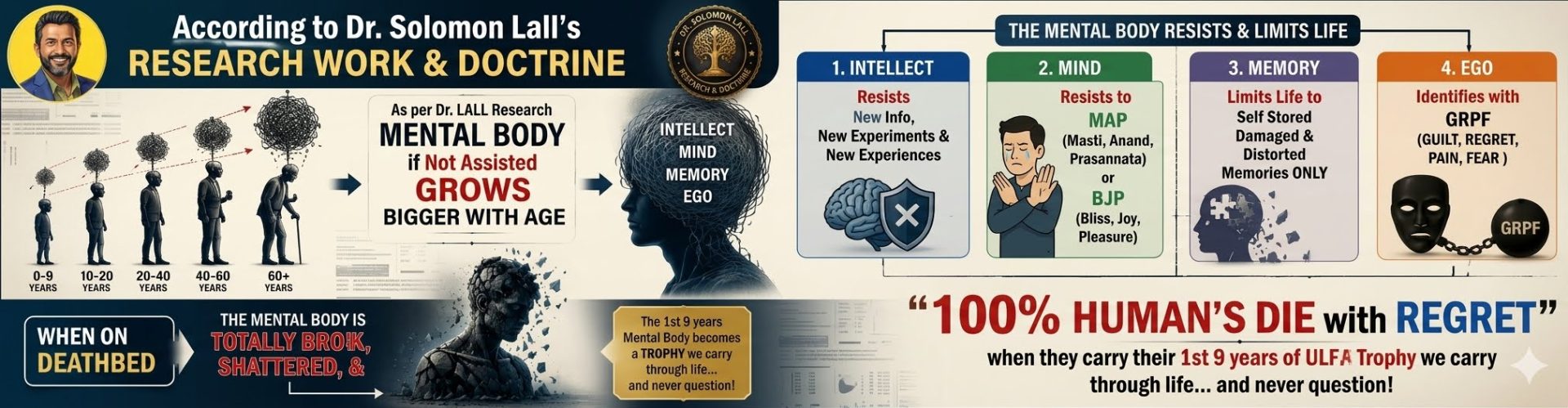
Dr. Solomon Lall’s psychology framework defines the mind in a specific way: the mind is the organ whose primary functions are thoughts, imagination, feelings, and emotions.
If you accept that definition, then school mental wellness requires:
– guidance of thought formation,
– shaping imaginative interpretation (how the child pictures possibilities, threats, futures),
– regulating feelings and emotional transitions,
– cultivating emotional habits that support resilience.
A hospital-driven framework—especially one focused on diagnostics and pharmacological interventions—may address extreme outcomes. But it will never create a preventive emotional environment for millions of children because it targets symptoms rather than the mind ecosystem.
So the “more counsellors” strategy, if it is still built as a late-stage remedy mechanism, will always be limited.
That leads to the fifth reason:
1. Counsellor-based models are often still downstream of the “mental illness” mentality.
2. They respond to disturbance rather than constructing the emotional ecosystem that prevents disturbance from deepening.
3. Therefore, the impact remains minor relative to the scale of the need.
—
“Counsellors” treats disturbance; the required intervention is mind-environment design
Let’s translate the “appointment more counsellors” concept into Dr. Lall’s framework.
If a child’s mind ecosystem is healthy:
– thoughts are guided,
– imagination supports constructive meaning rather than catastrophic fear,
– feelings are understood and integrated,
– emotions become manageable rather than overwhelming.
If this environment exists, then counsellors are not the first line of work—they become the specialized support system for exceptional cases: disturbances and imbalances that genuinely require intervention.
But if the school ecosystem does not create daily emotional cultivation, then counsellors are forced to behave like continuous fire extinguishers. At scale, that collapses under:
– time constraints,
– caseload,
– referral bottlenecks,
– and the inevitable reality that many forms of distress never enter formal routes.
So even if you appoint more counsellors, the system still cannot cover:
– every silent student,
– every subtle internal shift,
– every emotional misinterpretation that grows into behaviour.
Therefore:
1. More counsellors without mind-environment transformation can only improve triage, not prevention.
2. And in schools, prevention is where most of the value must concentrate.
That is why “more counsellors” has no major impact in the current scenario.
—
The Western precedent trap: copying methods without re-building the framework will fail in India
India cannot treat Western school mental wellness models as universal blueprints. Western systems are not irrelevant; they offer ideas. But replicating a structure designed for different societal contexts, different educational hierarchies, different family dynamics, different stress patterns, and different cultural meaning systems will not automatically succeed.
In the Indian school context:
– pressures can be intensified by examination structures,
– teacher-student power relations can feel rigid,
– social identity and family economics can amplify shame and fear,
– and stigma may reduce early disclosure of distress.
If you apply the same “counsellor deployment” structure without adapting the underlying mind theory into the education methodology, the programme will behave like an imported garment: it might fit superficially, but it won’t drape correctly and it won’t feel natural to the student’s life.
So the sixth reason:
1. Blind replication makes counsellor appointment a ritual rather than a functional transformation.
2. Without a uniquely designed Indian mind-environment framework, you will get numbers and compliance—not real emotional development.
—
Dr. Lall’s vision: a different school methodology that revisits what “Mind” is and how it functions
Dr. Solomon Lall’s psychology framework is not merely a critique. It provides a positive direction:
– The mind is one of the four major organ of the human “Mental body.”
– Its primary functions: thoughts, imagination, feelings, emotions.
– School mental wellness should therefore be about guiding the child’s internal functions, not just treating distress after it becomes visible.
This implies an education ecosystem with a new method:
1. The education system must revisit its assumptions about mental health.
– Mental health is not the same as mental illness.
– Mental wellness is not equivalent to hospital-style diagnostics.
2. The education system must embed mind-guidance into routine learning life.
– not only through “counselling sessions,”
– but through the daily environment: how teachers frame learning, how school culture interprets emotion, how discussions shape imagination and thought patterns.
3. Intervention should be tiered.
– Tier 1: ecosystem-level emotional cultivation (universal).
– Tier 2: counsellor intervention only when imbalance/disruption requires it (targeted).
When this happens, the school becomes an emotional training ground—not a complaint box and not a triage station.
That is why the “more counsellors” approach cannot be the main lever. It treats the emergency system as the core system. Dr. Lall’s framework changes the hierarchy.
—
Why the “whole concept of mental health in school” must become policy directives that transform education methodology—not staffing counts
The Times of India report describes the current policy as a “mental health policy introduced three months ago” but not converted into government order and operational deployment. That shows policy writing without execution intelligence.
But even if orders had been issued, the question would remain: would the policy direct schools to build a mind ecosystem—or would it merely direct schools to place counsellors?
If policy says “appoint counsellors,” schools will focus on counsellor availability. If policy says “build mind-guidance methodology into daily school culture,” schools must reform learning practices.
Therefore, the seventh reason “more counsellors” has no major impact (in the current scenario) becomes:
1. Because the policy approach is still the staffing-first approach, not methodology-first.
2. Because without mind-environment directives, counsellor appointment becomes the headline and not the transformation.
—
Reframing success: what matters is emotional development at scale, not the presence of a role
The “more counsellors” plan measures success by:
– number of counsellors appointed,
– number of visits conducted,
– number of sessions completed,
– number of complaints tracked.
But Dr. Lall’s framework measures success by:
– how children interpret thoughts,
– whether imagination is guided constructively,
– whether feelings and emotions are integrated rather than suppressed or exaggerated,
– whether emotional balance increases across the school population.
This difference in measurement changes everything. If you measure the wrong indicator, you build the wrong system even with good people.
So the eighth reason counsellor appointment will not create major impact is:
1. The system is likely optimizing outputs (visits, numbers, complaints) rather than inner mind functioning outcomes (thought-feeling-emotion harmony).
2. Without correct outcome orientation, the programme will never scale as meaningful transformation.
—
India needs a new education-based mental wellness framework, not a counsellor multiplication
The Times of India article shows mental health initiatives in Tamil Nadu schools in limbo:
– policy introduced but not operationalized,
– proposed counsellor deployments not ordered,
– wellness teams and trainings not implemented,
– tracking mechanisms losing seriousness,
– and the scheme eventually dropped for now.
This is exactly what happens when mental wellness is approached as a staffing-and-visit issue rather than as an education ecosystem design issue.
Dr. Lall’s psychology framework provides the alternative logic:
– mental wellness is about guiding the mind’s basic functions,
– school should cultivate emotional environment as a universal universal ecosystem,
– counsellors should support disturbances, not substitute the entire emotional environment,
– and Western replication without mind-framework redesign will fail.
So if the question is whether appointing more counsellors will create major impact right now, the answer, under this reasoning, is decisive:
No—because the programme’s core architecture is still incomplete, still bureaucratic, still late-stage, still dependent on delayed operationalization, and still oriented toward a hospital-like response mentality rather than a school-based mind-environment methodology.
The path forward is not merely scaling counsellors. The path forward is scaling the framework: a new methodology of managing emotional health and mental wellness across schools in India, where mind functioning—thoughts, imagination, feelings, emotions—becomes the education system’s living objective.
And when that happens, counsellors stop being the centre of the story. They become the specialized support in a system that already prevents most disturbances from deepening.
That is the kind of reform that doesn’t collapse under budget shifts, doesn’t die in administrative delays, and doesn’t fade when inspections stop. That is the kind of reform that finally turns policy into lived emotional development—at scale, across every classroom.