
Psychiatry is experiencing an ontological crisis. Despite decades of high-resolution neuroimaging, genome-wide association studies, and billions of dollars invested in neurochemical engineering, clinical psychiatry has reached a therapeutic plateau. Remission rates for major depressive disorder hover at disappointing baselines, psychiatric drug development is plagued by mechanistic dead-ends, and the diagnostic classifications of the DSM-5 continue to fracture under the weight of comorbid heterogeneity.
In this vacuum of fundamental innovation, an alluring siren song has emerged: neuropsychoanalysis.
Its chief architect and most articulate evangelist, the South African neuropsychologist and psychoanalyst Mark Solms, has mounted an ambitious rescue operation. In his landmark work, The Only Cure: Freud and the Neuroscience of Mental Healing, Solms attempts an audacious synthesis. He aims to exhume Sigmund Freud’s 19th-century clinical architecture, drape it in the mathematics of Karl Friston’s Free Energy Principle, validate it using functional neuroimaging, and present the Freudian couch as the ultimate, biologically grounded savior of modern mental health.
┌─────────────────────────────────────────────────────────────────────────────┐
│                       THE CORE EPISTEMIC MISDIRECTION                       │
│                                                                             │
│   1895: Hydraulic Drive Theory  ───(130 Years of Failure)───► Dead End     │
│                     │                                             ▲         │
│             [Technological]                                [Epistemic Loop] │
│             [ Acceleration]                                       │         │
│                     ▼                                             │         │
│   2026: Markov Blankets + Free Energy + fMRI ─────────────────────┘         │
│         "When a vector points in the wrong direction,                       │
│          accelerating velocity only guarantees arriving                     │
│          further from the truth."                                           │
└─────────────────────────────────────────────────────────────────────────────┘
Solms is not a naive dogmatist. He is a formidable scholar who famously discovered the forebrain dreaming network and has openly discarded Freud’s most indefensible ideas—namely, the death drive (Todestrieb) and early psychosexual phase dogmas.
Yet, beneath the sophisticated veneer of high-dimensional neuroscience, computational biophysics, and mathematical modeling, an uncomfortable truth persists: the Freudian system has not worked for over a century, and no amount of contemporary technological jargon can alter that baseline.
When the underlying foundational paradigm of a discipline points in the wrong direction, adding a powerful technological catalyst does not course-correct the trajectory. It amplifies the error. Tethering an fMRI scanner to a Victorian psychoanalytic couch does not validate legacy theory; it constructs an elaborate computational justification for a model of human suffering that remains clinically sluggish, epistemically untestable, and structurally flawed.
1. The High-Tech Retrofit: Dressing the Hydraulic Unconscious in Bayesian Attire
To understand why this neuropsychoanalytic synthesis fails, we must first examine how Solms builds his bridge between the 19th and 21st centuries.
Solms’s core project is the literal realization of Freud’s abandoned 1895 Project for a Scientific Psychology. Freud, originally a neuropathologist dissecting lamprey spinal cords, realized that 19th-century neurobiology lacked the tools to map the mind’s operations directly onto neuroanatomy. Consequently, he retreated into psychological metaphor, inventing an intricate hydraulic mythology of drives (Triebe), repressions (Verdrängung), cathexes (Besetzung), and ego defenses.
                  ┌──────────────────────────────────────────────┐
                  │          THE NEUROPSYCHOANALYTIC MAP         │
                  └──────────────────────────────────────────────┘
                                         │
                 ┌───────────────────────┴───────────────────────┐
                 ▼                                               ▼
     ┌────────────────────────┐                     ┌────────────────────────┐
     │   UPPER BRAINSTEM &    │                     │   CORTICAL MANTLE &    │
     │      PAG / VTA         │                     │       DLPFC / DMN      │
     ├────────────────────────┤                     ├────────────────────────┤
     │ • Raw Affective Core   │                     │ • Predictive Engine    │
     │ • Panksepp's 7 Systems │                     │ • Cognitive Control    │
     │ • The "Conscious Id"   │                     │ • Unconscious Ego      │
     │ • Source of Free Energy│                     │ • Markov Boundaries    │
     └────────────────────────┘                     └────────────────────────┘
Solms argues that contemporary neuroscience has finally caught up with Freud’s initial vision. To achieve this, he orchestrates a shotgun wedding between three distinct, highly complex scientific frameworks:
Jaak Panksepp’s Affective Neuroscience: Solms maps Freud’s drive apparatus onto Panksepp’s seven subcortical primary emotional command systems:
SEEKING,RAGE,FEAR,LUST,CARE,PANIC/GRIEF, andPLAY.The “Conscious Id” Inversion: In a radical departure from classical psychoanalysis, Solms asserts that raw consciousness originates not in the cortex, but in the upper brainstem (the periaqueductal gray, reticular activating system, and ventral tegmental area). The Id, therefore, is conscious feeling—raw affect. The Ego, by contrast, is primarily unconscious cognitive machinery: a cortical apparatus tasked with dampening subcortical drive states.
Karl Friston’s Free Energy Principle (FEP): Solms imports Friston’s variational thermodynamics. The mind-brain is conceptualized as a hierarchical Bayesian inference engine. Its existential objective is to minimize variational free energy (the mathematical upper bound on surprise or prediction error) across internal states surrounded by statistical Markov blankets.
Under this neuropsychoanalytic synthesis, neurotic suffering is re-theorized as an engineering failure: an inability of the cortical ego to construct stable, generative predictive models that successfully bind and minimize the free energy generated by subcortical emotional command systems. Repression is recast as the dynamic allocation of precision weighting to prior beliefs, preventing prediction errors from updating conscious working memory.
The Semantic Sleight of Hand
On paper, this sounds breathtakingly sophisticated. It appeals directly to academic psychiatrists and psychotherapists who are weary of coarse biological reductionism but still crave hard-scientific legitimacy.
However, when this intellectual scaffold is subjected to rigorous epistemic scrutiny, it unravels into an elaborate semantic substitution.
┌─────────────────────────────────────────────────────────────────────────────┐
│                 THE SEMANTIC RETROFIT: OLD METAPHORS TO NEW                 │
├───────────────────────────────┬─────────────────────────────────────────────┤
│ Classical Psychoanalysis      │ Computational Neuropsychoanalysis           │
├───────────────────────────────┼─────────────────────────────────────────────┤
│ Dynamic Unconscious Conflict  │ Failed Minimization of Variational Free     │
│                               │ Energy across Markov Blankets               │
│ Transference Resistance       │ Hyper-precise Priors Insulated from         │
│                               │ Ascending Prediction Errors                 │
│ Dynamic Repression            │ Down-weighting Sensory Precision to Shield  │
│                               │ Incompatible Generative Models              │
│ Libidinal / Ego Drives        │ Allostatic Deviation within Subcortical     │
│                               │ Neuromodulatory Networks (Pankseppian)      │
│ The Working-Through Process   │ Iterative Bayesian Belief Updating via      │
│                               │ Intersubjective Dyadic Attunement           │
└───────────────────────────────┴─────────────────────────────────────────────┘
Translating a legacy psychodynamic metaphor into computational physics does not change its operational validity. Labeling a patient’s avoidance “an un-updated prior insulated from sensory prediction error” does not demonstrate that Freud’s structural theory of dynamic conflict was right. It merely demonstrates that information theory and Bayesian mechanics are broad enough to serve as mathematical wallpaper for almost any phenomenological concept.
When you strip away the terms like variational divergence, Markov blankets, and subcortical affective valuation, you are left with the exact same clinical apparatus that psychoanalysts have used since 1910: free association, dream interpretation, transference analysis, and four-day-a-week clinical open-endedness.
2. The “Insulin” Metaphor: An Unintended Confession of Permanent Fragility
The conceptual cracks in Solms’s model widen considerably when he attempts to defend the clinical efficacy of psychoanalysis against pharmacological psychiatry. Solms makes a bold assertion: clinical psychoanalysis and its deep psychodynamic derivatives are as dependable and indispensable for mental disorders as insulin is for the management of type 1 diabetes.
Intended as an aggressive defense of psychoanalytic rigor, this metaphor is an unintended structural confession.
┌─────────────────────────────────────────────────────────────────────────────┐
│                       THE INSULIN METAPHOR BREAKDOWN                        │
│                                                                             │
│   TYPE 1 DIABETES (Metabolic)         PSYCHOLOGICAL DISTRESS (Dynamic)      │
│   ───────────────────────────         ────────────────────────────────      │
│   • Pancreatic beta-cell necrosis     • Plastic predictive architecture     │
│   • Irreversible biological void      • Adaptive behavioral loop            │
│   • Zero capacity for auto-synthesis  • Capable of allostatic learning      │
│   • Mandates exogenous lifetime dependency                                  │
│                                                                             │
│   THE SYSTEMIC IMPACT:                                                      │
│   Locking dynamic human suffering into the "Insulin Trap" pathologizes      │
│   resilience and institutionalizes perpetual clinical custody.              │
└─────────────────────────────────────────────────────────────────────────────┘
Consider what type 1 diabetes actually represents: an irreversible, organ-level metabolic pathology. The beta cells of the islets of Langerhans are destroyed. The body has permanently lost its capacity for self-regulation; it cannot synthesize insulin, no matter how much cognitive reframing, behavioral practice, or contextual adjustment occurs. The patient is bound to life-support via exogenous bio-intervention.
By equating the resolution of emotional suffering to insulin management, the neuropsychoanalytic model surrenders the core premise of mental health: plasticity, generative autonomy, and the resolution of suffering.
The Pathology of Chronic Custody
When applied to the psyche, the insulin metaphor introduces three destructive structural assumptions:
The Inherent Deficit Assumption: It frames the patient not as an adaptive agent navigating developmental constraints or challenging environments, but as a permanently damaged organism with an irremediable affective defect.
The Permanent Custody Mandate: If psychotherapy functions as insulin, it can never be truly finished. Ending therapy is framed as dangerous non-compliance. The patient is locked into open-ended, multi-year clinical maintenance, converting psychotherapy from an empowering educational arc into indefinite dependency.
The Obfuscation of Auto-Resolution: Human nervous systems possess innate, highly sophisticated capacities for allostatic adaptation, behavioral extinction, and structural neuroplasticity. Equating emotional distress to pancreatic necrosis fundamentally misunderstands neuroplasticity, denying the brain’s ability to update its internal generative models and re-establish equilibrium without indefinite clinical management.
This is the central paradox of the neuropsychoanalytic sales pitch: it borrows the language of predictive processing—a paradigm founded on dynamic, self-optimizing, adaptive networks—only to trap the human subject within a 19th-century pathology of permanent fragility.
3. The Case of Teddy P.: The Four-Year Archaeological Bottleneck
To see this theoretical model applied clinically, we need look no further than the centerpiece clinical case presented in The Only Cure: the treatment of Teddy P.
Teddy P., a practicing physician, presented to Solms with a debilitating constellation of treatment-resistant depression, severe somatic conversions, crippling executive burnout, psychogenic non-epileptic seizures, and intractable sexual dysfunction. He was heavily medicated on a psychotropic cocktail that had numbed his affect without resolving his functional despair.
Solms’s intervention was systematic: he carefully tapered Teddy off his pharmacological regimen and brought him onto the psychoanalytic couch.
The ultimate outcome was positive: Teddy’s somatic seizures vanished, his depressive paralysis lifted, his sexual function was restored, and he returned to clinical practice. Solms presents this as empirical proof of the neuropsychoanalytic paradigm.
┌─────────────────────────────────────────────────────────────────────────────┐
│             THE ARTIFACT OF RESOLUTION: TEDDY P.'S TREATMENT                │
│                                                                             │
│   [Presenting State] ──────────────( 4 YEARS / 600+ HRS )─────────────► [Recovery]
│   Severe Somatic Distress          Archaeological Dig                   Resolved Function
│                                                                             │
│   THE CLINICAL BOTTLENECK:                                                  │
│   Did recovery require 4 years of excavating historical childhood relics,   │
│   OR was it driven by basic, active, transdiagnostic agents of change?       │
│                                                                             │
│   1. Elimination of Iatrogenic Sedation (Medication Deprescribing)          │
│   2. Weekly Intersubjective Co-Regulation (Secure Attachment Base)          │
│   3. Exposure & Memory Reconsolidation (Extinction of Avoidance)             │
│   4. Spontaneous Neuroplastic Allostasis (Statistical Regression to Mean)   │
└─────────────────────────────────────────────────────────────────────────────┘
However, a critical clinical audit reveals a glaring issue: the intervention required four years of intensive, multi-session-per-week psychoanalysis—totaling hundreds of hours of clinical time.
Presenting a four-year timeline as a modern therapeutic triumph illustrates the profound clinical bottleneck at the heart of the psychoanalytic approach.
The Archaeological Fallacy
Solms achieved this result by leaning heavily on the classic Freudian archaeological metaphor: the belief that to resolve current dysfunction, the clinician must excavate every layer of childhood development, trace every historical root of infantile conflict, and decode the patient’s transferential regressions over hundreds of hours.
Modern cognitive and computational neuroscience explicitly contradicts this archaeological view:
┌─────────────────────────────────────────────────────────────────────────────┐
│                 ARCHAEOLOGICAL VS. PREDICTIVE PROCESSING                     │
├───────────────────────────────────────┬─────────────────────────────────────┤
│ The Freudian Archaeological Model     │ The Active Predictive Mind Model    │
├───────────────────────────────────────┼─────────────────────────────────────┤
│ • Memory as a static, stored fossil   │ • Memory as a dynamic, generative   │
│   to be uncovered intact.             │   reconstruction engine.            │
│ • Pathogenesis resides exclusively in │ • Pathology is sustained by active, │
│   historical trauma points.           │   present-day predictive loops.     │
│ • Linear historical excavation is a   │ • Targeted interventions unlock     │
│   prerequisite for symptom relief.    │   rapid memory reconsolidation.     │
│ • Long-term analysis is required to   │ • Behavioral perturbation drives    │
│   dissolve ancient resistances.       │   rapid predictive updates.         │
└───────────────────────────────────────┴─────────────────────────────────────┘
The brain does not store memories as immutable historical artifacts that must be uncovered to relieve pressure on the present. Memory is a dynamic, reconstructive process. The brain operates as a real-time predictive machine oriented entirely toward the present and immediate future. Its models are updated not through prolonged historical excavation, but through actionable prediction error loops and targeted memory reconsolidation.
When Teddy P. recovered after four years, what actually drove the change? Was it the exhaustive decoding of his childhood psychodynamics? Or was it the convergence of four well-established, non-Freudian therapeutic mechanisms?
Systematic Deprescribing: Systematically tapering off an iatrogenic cocktail that was blunting his dopaminergic signaling and causing somatic side effects.
Dyadic Co-Regulation: Providing a stable, attentive intersubjective container over several years, which acted as a secure attachment base to down-regulate chronic autonomic nervous system hyperarousal.
Natural Memory Reconsolidation: Bringing feared emotional states into conscious working memory in a safe environment, allowing natural synaptic reconsolidation to update the emotional valence of those memories.
Behavioral Desensitization: Gradual exposure to suppressed emotions, leading to the extinction of his somatic conversion patterns.
None of these active mechanisms require Freudian metapsychology. They are foundational, transdiagnostic neurobiological processes. By attributing the cure to psychoanalysis, Solms commits a classic category error: attributing the recovery to his theoretical dogma rather than the fundamental biological mechanisms of neuroplasticity and emotional processing.
4. The Mumbo-Jumbo Problem: Catalyzing False Vectors
To understand why integrating high-level mathematics and neuroimaging into legacy psychoanalysis is inherently flawed, we must examine a foundational principle in the philosophy of science:
When a conceptual framework points in the wrong direction, applying an intellectual catalyst does not correct the trajectory—it accelerates the divergence from reality.
                              THE FALSE VECTOR PRINCIPLE

                                            / [High Acceleration / False Direction]
                                           /  (FEP + fMRI + Neuropsychoanalysis)
                                          /
                                         /
      TRUE PHENOMENON                   /   Vector Divergence Error (θ)
     ==================================►─────────────────────────────────────►
     (Dynamic Plasticity, Systems      \
      Biology, Precision Medicine)      \
                                         \
                                          \   Traditional Mechanistic Blindness
                                           \  (Static Reductionist Psychiatry)
Consider the history of medicine. In the 16th and 17th centuries, the dominant medical paradigm was Galenic humorism: the belief that health depended on balancing four bodily humors (blood, phlegm, black bile, and yellow bile).
When early microscopes and anatomical dissection tools emerged, humorists did not discard their flawed framework. Instead, they used these new tools to observe bodily fluids in unprecedented detail, generating complex justifications for why an imbalance of “phlegm particles” caused fever. They took a cutting-edge technological catalyst and applied it to a flawed theoretical vector.
The result was not a medical breakthrough; it was a distraction that delayed the discovery of cellular pathology and germ theory by generations.
┌─────────────────────────────────────────────────────────────────────────────┐
│                    HISTORICAL PARALLELS: THE CATALYZED VECTOR               │
├──────────────────────┬────────────────────────┬─────────────────────────────┤
│ Historical Epoch     │ Flawed Foundational    │ High-Tech Catalyst          │
│                      │ Vector                 │ Applied                     │
├──────────────────────┼────────────────────────┼─────────────────────────────┤
│ 17th-Century         │ Galenic Humorism &     │ Early Microscopy &          │
│ Medicine             │ Bodily Fluids          │ High-Precision Anatomical   │
│                      │                        │ Dissection                  │
├──────────────────────┼────────────────────────┼─────────────────────────────┤
│ 19th-Century         │ Phrenology & Cerebral  │ Precision Craniometers &    │
│ Neuroscience         │ Craniometry            │ High-Resolution Calipers    │
├──────────────────────┼────────────────────────┼─────────────────────────────┤
│ 21st-Century         │ Freudian Psycho-       │ Functional Neuroimaging     │
│ Psychiatry           │ dynamic Structuralism  │ (fMRI) & Free Energy        │
│                      │                        │ Mathematics                 │
└──────────────────────┴────────────────────────┴─────────────────────────────┘
The exact same dynamic is playing out in neuropsychoanalysis.
Freud’s structural drive theory has failed to establish itself as a reliable, scalable, and testable framework for over a century. It has repeatedly fractured into dogmatic sects (Kleinian, Lacanian, Jungian, Kohutian, Bionian), produced weak and inconsistent clinical trial outcomes, and failed to offer scalable solutions for public mental health.
Taking Karl Friston’s Free Energy Principle—a brilliant, rigorous formulation of non-equilibrium steady-state thermodynamics—and using it to explain away Freudian repression is the modern equivalent of using high-resolution calipers to measure phrenological skull bumps.
It is complex, intellectually dazzling jargon that offers an illusion of hard science, but does nothing to fix the structural flaws of the underlying theory.
5. Comparative Architectural Breakdown: Four Competing Paradigms
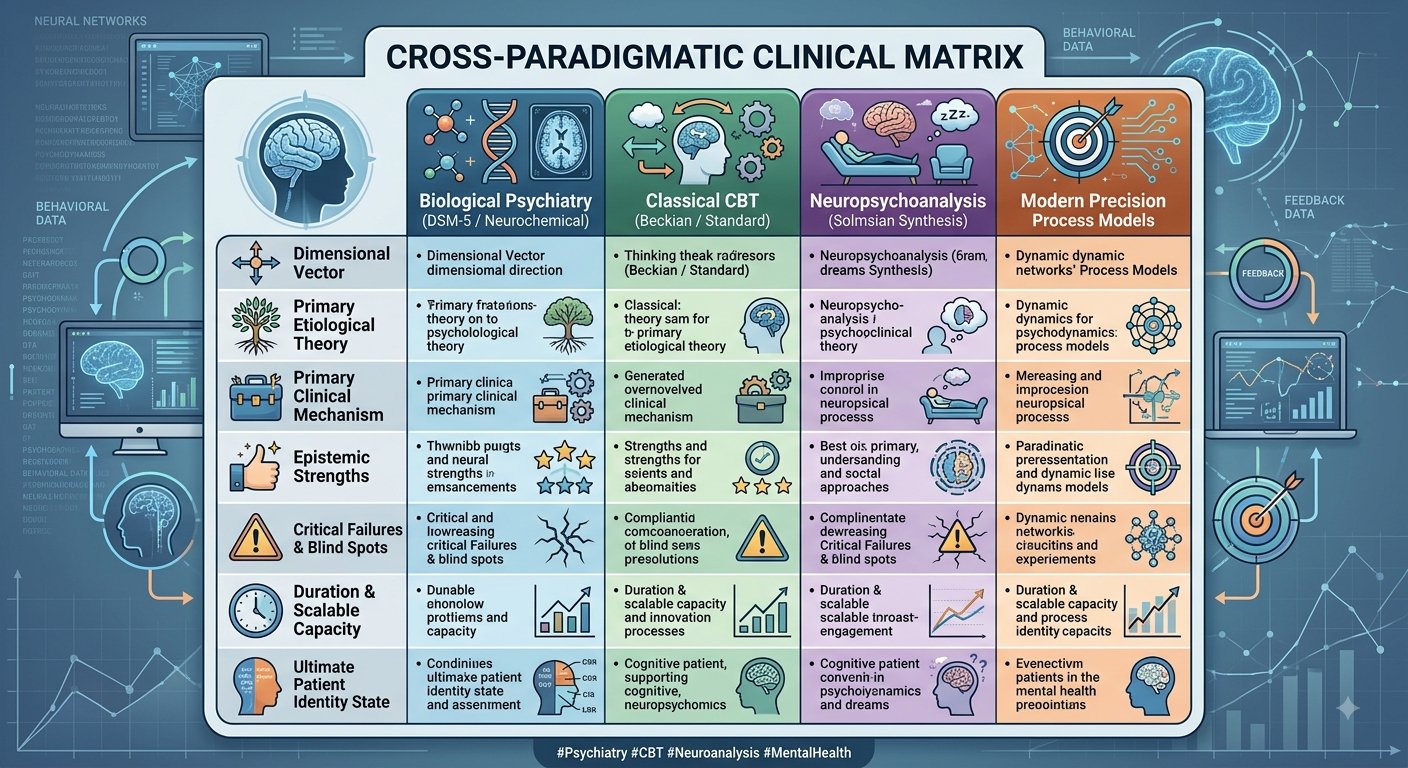
To locate neuropsychoanalysis on the broader map of contemporary clinical science, we must evaluate it alongside the three other dominant paradigms in mental health: Biological Reductionist Psychiatry, Standard Cognitive Behavioral Therapy (CBT), and Modern Process-Based / Affective-Reconsolidation Therapies.
┌─────────────────────────────────────────────────────────────────────────────────────────────────────────────────────────────────┐
│                                            CROSS-PARADIGMATIC CLINICAL MATRIX                                                   │
├──────────────────────┬─────────────────────────────┬─────────────────────────────┬────────────────────────┬─────────────────────┤
│ Dimensional Vector   │ 1. Biological Psychiatry   │ 2. Classical CBT            │ 3. Neuropsychoanalysis │ 4. Modern Precision │
│                      │    (DSM-5 / Neurochemical) │    (Beckian / Standard)     │    (Solmsian Synthesis)│    Process Models   │
├──────────────────────┼─────────────────────────────┼─────────────────────────────┼────────────────────────┼─────────────────────┤
│ Primary Etiological  │ Broken neurochemistry;      │ Distorted cognitive schemas │ Failed Bayesian energy │ Rigid, maladaptive  │
│ Theory               │ synaptic receptor           │ and behavioral maintenance  │ minimization; repressed│ generative priors;  │
│                      │ imbalances (Monoamines).    │ cycles.                     │ subcortical drives.    │ network allostasis. │
├──────────────────────┼─────────────────────────────┼─────────────────────────────┼────────────────────────┼─────────────────────┤
│ Primary Clinical     │ Exogenous receptor ligands  │ Cognitive restructuring;    │ Open-ended couch work; │ Targeted mismatch   │
│ Mechanism            │ (SSRIs, SNRIs, Anti-        │ conscious behavioral        │ dream work; historical │ learning; memory    │
│                      │ psychotics, Mood Modifiers).│ experiments.                │ transference analysis. │ reconsolidation.    │
├──────────────────────┼─────────────────────────────┼─────────────────────────────┼────────────────────────┼─────────────────────┤
│ Epistemic Strengths  │ Highly scalable; rapid      │ Empirically testable; brief;│ Honors rich subjective │ Rigorous, precise,  │
│                      │ stabilization for acute     │ easily standardized across  │ experience; integrates │ neuroplastically    │
│                      │ crisis management.          │ clinical populations.       │ affect with neurology. │ testable, scalable. │
├──────────────────────┼─────────────────────────────┼─────────────────────────────┼────────────────────────┼─────────────────────┤
│ Critical Failures &  │ High relapse rates; treats  │ Often mechanistic; blunts   │ Massive bottleneck;    │ Requires active,    │
│ Blind Spots          │ downstream markers; risks   │ somatic-affective drivers;  │ non-falsifiable roots; │ skilled clinicians; │
│                      │ chemical dependency traps.  │ high cognitive relapse.     │ classist access costs. │ ongoing taxonomy.   │
├──────────────────────┼─────────────────────────────┼─────────────────────────────┼────────────────────────┼─────────────────────┤
│ Duration & Scalable  │ Lifelong maintenance;       │ Short-term (8 to 20         │ Multi-year (3 to 6+    │ Short-to-medium     │
│ Capacity             │ highly scalable.            │ sessions); highly scalable. │ years); non-scalable.  │ (6 to 24 sessions). │
└──────────────────────┴─────────────────────────────┴─────────────────────────────┴────────────────────────┴─────────────────────┤
│ Ultimate Patient     │ Medicated client dependent  │ Skilled self-manager of     │ Archeologically mapped,│ Autonomous agent    │
│ Identity State       │ on molecular stabilizers.   │ cognitive-behavioral loops. │ perpetual couch client.│ with updated priors.│
└──────────────────────┴─────────────────────────────┴─────────────────────────────┴────────────────────────┴─────────────────────┤
The Diagnostic Takeaway
Biological Reductionist Psychiatry fails because it treats complex, emergent network states as simple chemical deficiencies, turning transient suffering into chronic medical conditions.
Standard CBT often struggles with deeper emotional challenges because it prioritizes conscious cognitive restructuring over the subcortical, somatic circuits where severe distress is generated and maintained.
Neuropsychoanalysis correctly identifies the importance of subjective affect and subcortical drives, but it tethers these insights to an inefficient, non-falsifiable, century-old clinical delivery system.
Modern Process-Based and Reconsolidation Paradigms (e.g., Coherence Therapy, Accelerated Experiential Dynamic Psychotherapy, Emotion-Focused Therapy, and Contemporary Active Inference Clinical Models) bypass the psychoanalytic bottleneck entirely. They target the brain’s natural memory reconsolidation processes directly, achieving lasting structural updates in weeks or months rather than years.
6. Deconstructing the Flawed Foundations of Neuropsychoanalysis
To move clinical psychology and psychiatry forward, we must separate Solms’s genuine scientific contributions from the unworkable Freudian assumptions he attempts to preserve.
┌─────────────────────────────────────────────────────────────────────────────┐
│                 FOUR FLAWS OF THE NEUROPSYCHOANALYTIC MODEL                 │
│                                                                             │
│   1. The Pan-Oedipal Epistemic Trap                                         │
│      (Non-falsifiable confirmation bias masked as deep insight)             │
│                                                                             │
│   2. The Iatrogenic Cultivation of Transference                             │
│      (Manufacturing clinical dependency rather than building autonomy)      │
│                                                                             │
│   3. The Misunderstanding of Neuroplasticity                                │
│      (Treating memory as an ancient fossil instead of an active prediction) │
│                                                                             │
│   4. The Socioeconomic Exclusion Bottleneck                                 │
│      (A boutique, high-cost therapy masquerading as a universal solution)   │
└─────────────────────────────────────────────────────────────────────────────┘
Flaw 1: The Pan-Oedipal Epistemic Trap (Non-Falsifiability)
The greatest scientific weakness of the classical Freudian model has always been its immunity to empirical disconfirmation.
If a patient confirms the analyst’s interpretation, the interpretation is deemed correct.
If the patient rejects the interpretation, they are displaying “resistance” (Widerstand), which the analyst takes as further proof that the interpretation struck a repressed nerve.
Neuropsychoanalysis preserves this non-falsifiable loop by cloaking it in predictive processing language:
“The patient’s conscious ego is deploying precision weighting to down-regulate the sensory prediction error generated by subcortical emotional command systems.”
By dressing non-falsifiable clinical interpretations in Bayesian terminology, the model becomes even harder to test and challenge. A clinical model that cannot be proven wrong inside the consulting room cannot generate reliable scientific discoveries. It is a closed belief system.
Flaw 2: The Iatrogenic Cultivation of Transference
Classical analysis relies on creating an artificial, asymmetric relationship: the patient lies on a couch, unable to see the therapist’s face, projecting unresolved infantile attachments onto a blank-slate analyst.
From a modern neurobiological and attachment perspective, this setup is often counterproductive:
┌─────────────────────────────────────────────────────────────────────────────┐
│                THE IATROGENIC TRANSFERENCE TRAP IN PRACTICE                 │
│                                                                             │
│   ANALYTIC SETUP:                                                           │
│   Supine patient + Visually absent analyst + Asymmetric blank slate         │
│                               │                                             │
│                               ▼                                             │
│   NEUROBIOLOGICAL REACTION:                                                 │
│   Sensory deprivation + Elevated social uncertainty (Free Energy Spike)     │
│                               │                                             │
│                               ▼                                             │
│   DOWNSTREAM OUTCOME:                                                       │
│   Triggers artificial regression and fuels iatrogenic attachment            │
│   dependency, mistaking a manufactured crisis for natural insight.          │
└─────────────────────────────────────────────────────────────────────────────┘
When you place a distressed patient in sensory deprivation and deny them facial feedback, you introduce massive relational ambiguity. The brain’s predictive machinery responds to this high uncertainty by cycling through regressive, worst-case attachment models.
The analyst then analyzes this “transference” as if it were a natural reflection of the patient’s early childhood conflicts. In reality, the environment itself is often generating the very instability it claims to cure.
Modern attachment neuroscience shows that emotional healing is driven by clear, intersubjective attunement—face-to-face, eye-to-eye co-regulation—not by manufactured ambiguity.
Flaw 3: Treating Memory as an Ancient Fossil
The Freudian paradigm assumes that neuroses are driven by repressed, unconscious memories locked deep in the developmental past, which must be carefully unearthed.
Modern neurobiology has overturned this concept. Landmark work on Memory Reconsolidation (e.g., Nader, Alberini, Ecker) shows that:
Long-term memory is fundamentally dynamic, reconstructive, and plastic.
When a long-term implicit memory is retrieved into conscious working memory under conditions of a prediction mismatch (experiencing something that contradicts the old expectation), the underlying neural trace becomes temporarily labile.
During this open reconsolidation window (lasting roughly 4 to 6 hours), the target neural trace can be updated, transformed, or rewritten at the synaptic level.
┌─────────────────────────────────────────────────────────────────────────────┐
│                 THE TARGETED RECONSOLIDATION TIMELINE                       │
│                                                                             │
│   [Target Implicit Memory] ──► [Activated in Conscious Working Memory]      │
│                                                   │                         │
│                                                   ▼                         │
│                                     [Experience Prediction Mismatch]        │
│                                     (Violation of Old Expectation)          │
│                                                   │                         │
│                                                   ▼                         │
│                                     [Reconsolidation Window: ~4-6 Hours]   │
│                                     (Synaptic De-potentiation / Rewriting)  │
│                                                   │                         │
│                                                   ▼                         │
│                                     [Memory Permanently Updated]            │
│                                     (Resolution in Sessions, Not Years)     │
└─────────────────────────────────────────────────────────────────────────────┘
This discovery fundamentally challenges the psychoanalytic approach. Unlocking deep emotional change does not require years of free association to unearth childhood memories. It requires targeted, experiential activations that pair old emotional patterns with vivid, contradictory experiences.
When done precisely, the brain rewrites maladaptive models in a matter of weeks, rendering the four-year archaeological dig obsolete.
Flaw 4: The Socioeconomic Exclusion Bottleneck
Any therapeutic model that requires 3 to 5 sessions per week over multiple years is fundamentally inaccessible to the vast majority of people.
┌─────────────────────────────────────────────────────────────────────────────┐
│               THE ARISTOCRATIC NATURE OF PSYCHOANALYSIS                     │
│                                                                             │
│   5 Sessions/Week  ×  $250/Session  ×  4 Years  =  $260,000+               │
│                                                                             │
│   A therapeutic framework that requires years of intensive, out-of-pocket   │
│   investment cannot serve as the operational standard for global            │
│   psychiatry. It is a luxury good for the wealthy elite.                    │
└─────────────────────────────────────────────────────────────────────────────┘
Touting psychoanalysis as “The Only Cure” is not just scientifically questionable—it is structurally unviable for public healthcare. A genuine clinical solution must be effective, reliable, and scalable across diverse socioeconomic populations.
7. The Forward Vector: A Rigorous, Scalable Framework for Mental Health
If we reject both the blunt reductionism of biological psychiatry and the inefficient bottleneck of neuropsychoanalysis, what does a viable, modern clinical science look like?
The path forward requires building on a clean, testable vector: Integrating Predictive Processing with Targeted Affective Reconsolidation and Systems Biology.
┌─────────────────────────────────────────────────────────────────────────────┐
│                THE MODERN VECTOR: INTEGRATED SYSTEMS MEDICINE               │
│                                                                             │
│   ┌─────────────────────────────────────────────────────────────────────┐   │
│   │ 1. Somatic & Allostatic Optimization                                │   │
│   │    (Sleep, metabolic health, neuroinflammation, autonomic balance)  │   │
│   └──────────────────────────────────┬──────────────────────────────────┘   │
│                                      ▼                                      │
│   ┌─────────────────────────────────────────────────────────────────────┐   │
│   │ 2. Phenomenological & Affective Precision Mapping                   │   │
│   │    (Pankseppian subcortical drives, relational dynamics, attachment)│   │
│   └──────────────────────────────────┬──────────────────────────────────┘   │
│                                      ▼                                      │
│   ┌─────────────────────────────────────────────────────────────────────┐   │
│   │ 3. Target Prediction Error Mismatches (Memory Reconsolidation)      │   │
│   │    (Active experiential exercises, real-time behavioral updates)    │   │
│   └──────────────────────────────────┬──────────────────────────────────┘   │
│                                      ▼                                      │
│   ┌─────────────────────────────────────────────────────────────────────┐   │
│   │ 4. Clear Therapeutic Graduation                                     │   │
│   │    (Building autonomous, self-optimizing psychological health)      │   │
│   └─────────────────────────────────────────────────────────────────────┘   │
└─────────────────────────────────────────────────────────────────────────────┘
This integrated approach is built on four evidence-based pillars:
1. Structural Allostatic Stabilization
Before undertaking deep psychological interventions, clinicians must stabilize the patient’s underlying physiology. Chronic neuroinflammation, metabolic dysfunction, circadian rhythm disruption, and autonomic nervous system dysregulation lock the brain into rigid, high-entropy threat states.
Resolving these physiological stressors restores the neural flexibility needed for learning and therapeutic growth.
2. Precise Phenomenological Mapping
Rather than spending months on open-ended historical excavation, the clinician quickly works with the patient to map their current predictive models:
What specific subcortical emotional drives are signaling unmet needs?
What implicit assumptions predict danger, rejection, or abandonment if those needs are expressed?
What avoidant behaviors or somatic conversion patterns is the system deploying to minimize prediction error?
3. Active Prediction-Mismatch and Targeted Reconsolidation
Rather than relying on passive cognitive restructuring or open-ended interpretation, therapy focuses on creating visceral, experiential mismatches:
Activating the implicit emotional schema in conscious experience.
Introducing a clear, undeniable contradictory experience that violates the old prediction.
Facilitating the synaptic reconsolidation window to update and integrate the revised model.
This process targets deep emotional structures directly, producing lasting changes in days and weeks rather than years.
4. Clear Therapeutic Graduation
The explicit objective of therapy is to establish a resilient, self-governing individual who no longer needs clinical intervention. The patient is not a lifelong invalid in need of emotional insulin; they are an adaptive learner equipped with updated predictive models and the tools to navigate future life challenges autonomously.
8. Summary: Escaping the Sunk-Cost Trap of Legacy Psychology
Mark Solms’s The Only Cure is an intellectually ambitious, deeply scholarly book written by an exceptional neuroscientist. His integration of Jaak Panksepp’s affective neuroscience and his identification of the “Conscious Id” are genuine contributions that help dismantle the sterile, overly cognitive models of early computational psychiatry.
However, the book’s core premise—that these modern scientific discoveries validate Freud’s 19th-century clinical architecture—is an epistemic dead end.
┌─────────────────────────────────────────────────────────────────────────────┐
│                            THE CRITICAL TAKEAWAY                            │
│                                                                             │
│   You cannot fix a century of clinical failure simply by translating        │
│   old concepts into cutting-edge mathematical language.                     │
│                                                                             │
│   Progress in psychiatry and clinical psychology will not come from         │
│   rehabilitating Victorian dogmas with modern brain imaging.                │
│                                                                             │
│   It will come from building a falsifiable, scalable, and practical         │
│   science of the mind—one that honors the depth of human emotion            │
│   without trapping the patient in permanent clinical custody.               │
└─────────────────────────────────────────────────────────────────────────────┘
Mental health does not need a retrofitted 19th-century framework wrapped in 21st-century jargon. It needs a clear, forward-looking commitment to translational neuroscience, targeted memory reconsolidation, and scalable clinical models that deliver genuine, autonomous healing.
Frequently Asked Questions
Isn’t neuropsychoanalysis supported by empirical neuroimaging?
Neuroimaging demonstrates that psychodynamic experiences correlate with specific patterns of subcortical and cortical brain activity, but this is true for all conscious experiences. Demonstrating that an emotional state activates the periaqueductal gray or alters default mode network connectivity does not validate Freud’s structural theories of the ego, id, and repression. It simply confirms that mental phenomena have biological correlates.
Why is the Free Energy Principle insufficient to validate psychoanalysis?
Karl Friston’s Free Energy Principle is a universal mathematical framework for understanding how self-organizing systems maintain their integrity by minimizing surprise. Because it is an abstract principle, it can be applied to almost any dynamic process—from single-celled organisms to complex economies. Using it to describe psychoanalytic concepts translates those ideas into the language of physics, but it does not prove that psychoanalysis is an effective or efficient clinical intervention.
How does memory reconsolidation differ from traditional psychoanalytic working-through?
Traditional psychoanalytic “working-through” involves an extended, multi-year process of historical excavation, dream analysis, and working through transference resistance to make the unconscious conscious. In contrast, memory reconsolidation is a precise, time-limited neurobiological mechanism. When an implicit emotional memory is activated alongside an experiential prediction error, the underlying neural trace becomes labile and can be rewritten at the synaptic level within hours, achieving lasting change without years of analysis.
If both biological psychiatry and psychoanalysis are limited, where should clinicians focus?
Clinicians should focus on evidence-based, process-oriented frameworks that combine systems biology with affective neuroscience and memory reconsolidation. Models like Process-Based Therapy (PBT), Coherence Therapy, Emotion-Focused Therapy (EFT), and modern active-inference approaches focus on identifying and updating maladaptive predictive models in the present. This delivers deep, lasting change while supporting patient autonomy and preserving healthcare resources.
The original article was published on the linkedin Newsletter by Dr. Lall – https://www.linkedin.com/pulse/architecture-misdirection-how-modern-psychiatry-mistook-dr-s-lall-cfgbf
Dr. Lall Psychology & MindCare Services
Promotional Video : https://www.youtube.com/watch?v=T8OQ2YwKoe0
Quantum Psychology Experiential Program
Admission Form Available at : https://www.amazonauthor.in
YouTube Subscribe : https://www.youtube.com/@drlallpsychology
Linkedin Connect : https://www.linkedin.com/in/drlallpsychology
Linkedin Follow : https://www.linkedin.com/company/drlallpsychology
WhatsApp Channel : https://whatsapp.com/channel/0029VbDEEVb4o7qRCY6UEp38
To Buy Books – by – Dr. Solomon Lall 3-PhDs : Author, Mind Research Scientist, Grahastya YogRishi, Sr. Consultant : Emotional Health & Mental Wellness.
Most Popular, Acclaimed and Renowned Published Book, Now on Amazon book Stores throughout the world
Author Page : https://www.amazon.com/author/drlall
1) https://a.co/d/09tTuF6s : Quantum Psychology: Freedom from Painful Mind Matters
2) https://a.co/d/045dAL7q : Mental Hygiene is The New Dental Hygiene: The Science & Art of Keeping your Mind Clean
3) https://a.co/d/02a2WXGT : Menopause – The Mindful Pause: Redefining Menopause Through Mental Hygiene, Science, and Self-Discovery
4) https://a.co/d/01s1ae3A : Sanātan Psychology: The Science & Wisdom of Ancient Bhārata
5) https://a.co/d/0j3WmYTP : Quantum Biology: Healing the Mind With Secret Science
6) https://a.co/d/0dOByGYF : 1-3 : Quantum BioHack: The Secrets of Energy, Vibrations, Frequency & The Rhythmic Healing
7) https://a.co/d/0cPAiaQg : 2-3 : Quantum BioHack: The Secrets of Energy, Vibrations, Frequency & The Rhythmic Healing
8) https://a.co/d/0dnGlHR3 : 3-3 : Quantum BioHack: The Secrets of Energy, Vibrations, Frequency & The Rhythmic Healing
9) https://a.co/d/02XShiQh : Wired For JOY: A science-backed, heart-centered exploration of your happy hormones
10) https://a.co/d/05uD1fnf : Grahastya Yoga: The Supreme Yoga for Everyone
11) https://a.co/d/0eZn6yPF : Quantum Parenting: Parenting in the AI Age
12) https://a.co/d/03ybLa0Q : The CODD Problem : Cortisol Overload and Dopamine Deficiency.
13) https://a.co/d/00WOJjAr : Where is Your Mind Located: The Bhoot Blueprint
14) https://a.co/d/0hS1J6xK : Beyond Maya: Awakening the Mind’s Secret Science
For School & University Mental Wellness Partnerships :
For Schools – Download Flyer – (Very Popular) : https://drive.google.com/file/d/1qJ8uoDlHK7Pr0iXmID5oMFv-DkxbzV0H
For Campus – Campus Influencer Program –
https://drive.google.com/file/d/1UBFaSfoGQGBOg86G0uIgr4SUigg3n0pF
send Your Resume to mindlabs@authordrlall.com
To Check all Ongoing Job Opportunities. Study the Job Descriptions from our Associates Linked Posts :
: Social Media Content Creator – All over India. : https://www.linkedin.com/jobs/view/4435409715/
: University, School & Campus Influencer – All over India : https://www.linkedin.com/jobs/view/4433157584/
: Associate Psychologist – All over India.
https://www.linkedin.com/jobs/view/4436464924
Dr. Solomon Lall Psychology & MindCare Services is a premier emotional health and mental wellness practice delivering trusted, evidence-based psychological care. Led by Dr. Solomon Lall (23+ years experience, 2,500+ clients, 12,500+ therapy hours), the practice blends ancient Vedic mental body yogic concepts with modern mind sciences.
We provide holistic, tailored online services worldwide using a proprietary Quantum Psychology Blueprint and Quantum Biohack Framework. Specialized programs address emotional discovery, recovery, loneliness, pain, and age-specific mental health needs for individuals and corporates.
https://drlallpsychology.com
https://drsolomonlall.com
https://lalldr.com
https://whereismytherapy.com
https://leadpsychologist.com