
The Psychotherapy Field Is a Structural Mess—and Why “Imposter Syndrome” Isn’t Only Personal
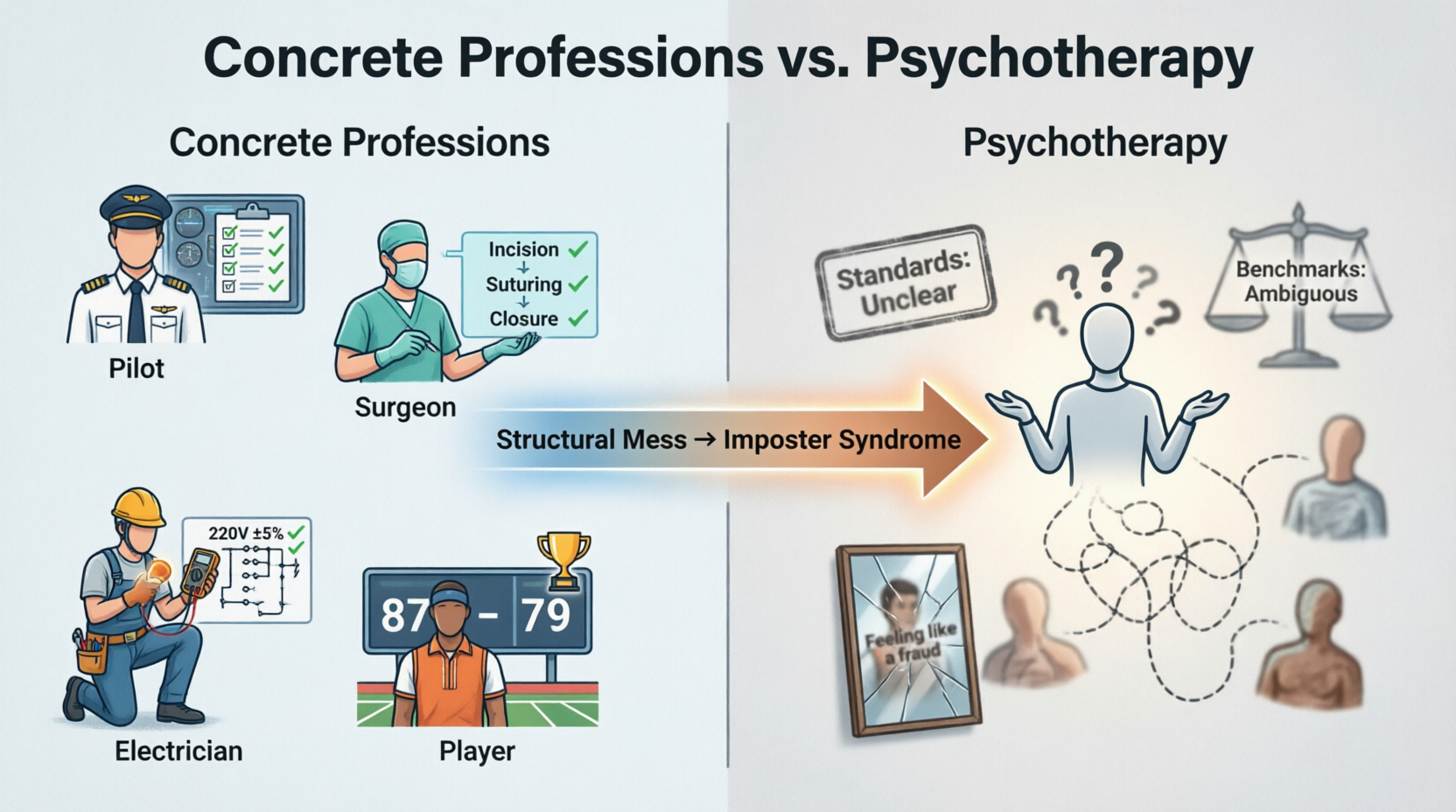
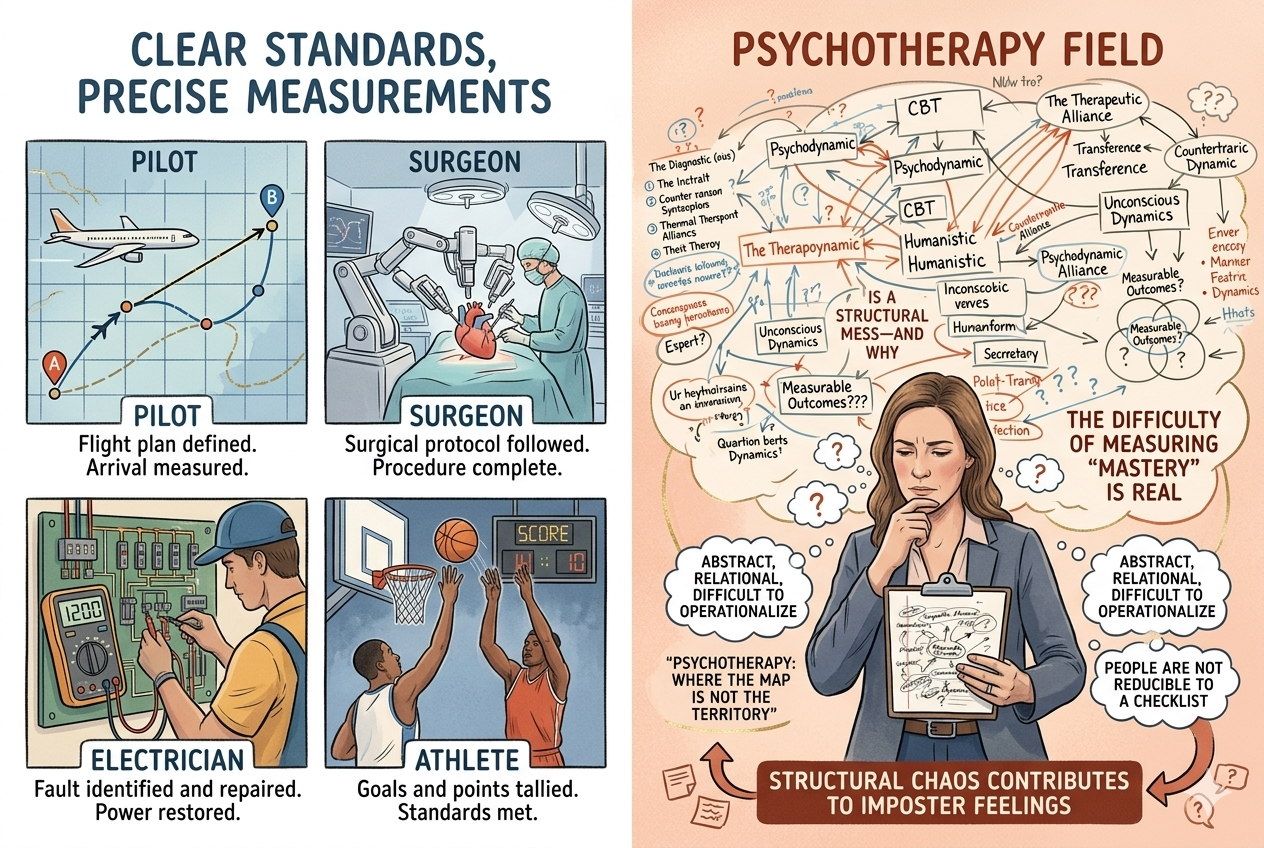
In many professions, competence can be described with clarity and measured with precision. A pilot navigates from point A to point B. A surgeon completes a defined procedure. An electrician diagnoses and repairs. A player hits a score that can be tallied. There are standards, benchmarks, and observable outcomes.
Psychotherapy feels different—more abstract, more relational, more difficult to operationalize. Human experience is complex, and people are not reducible to a checklist. In that sense, the difficulty of measuring “mastery” is real.
But something else is also true: the profession asks therapists to develop mastery within a system that cannot even agree on what mastery is supposed to look like.
Therapists are often instructed to trust themselves before they have a meaningful way to evaluate themselves accurately. They are handed immense emotional responsibility with surprisingly limited observation, inconsistent standards, contradictory supervision, and little to no universally agreed-upon definition of what “good therapy” actually entails.
When therapists feel overwhelmed—which many inevitably do—they are frequently met with a familiar solution: work on “imposter syndrome” through therapy, supervision, self-compassion, and “trust the process.”
The problem is that “trust the process” doesn’t answer the practical question: What if I genuinely don’t know what I’m doing?
The Field Can’t Agree on What Therapy Is (Or What It Isn’t)
What therapists are expected to do depends heavily on who you ask.
One approach emphasizes relational depth and attachment. Another emphasizes behavioral change and symptom reduction. Another prioritizes body-based tracking and nervous system regulation. Another leads with cognitive restructuring. Training programs can even encourage a political and cultural re-framing of what “therapy” should mean—at times treating decolonization of methods as central rather than peripheral.
Even the boundaries of what counts as illness keep shifting. Diagnostic systems have expanded dramatically over time. And meanwhile, therapy has become a mainstream recommendation for nearly every kind of human suffering: grief, burnout, loneliness, career confusion, low self-esteem, existential dread, family rupture, trauma, anxiety, depression—and many experiences that are hard to sort into neat categories between “pathology” and “being human.”
This expansion isn’t inherently wrong. People deserve access to support that can meet them where they are. But as the field grows broader, the challenge of defining therapeutic purpose intensifies. The therapist must wrestle with ambiguity—while the patient arrives expecting expertise, clarity, relief, and real transformation.
Therapists Are Asked to Practice Before They Can Actually Watch Practice
Over the years, many therapists and supervisees share a consistent desire: to be a good clinician and to truly help. They study theories. They memorize ethical and legal boundaries. They learn about different presenting concerns—relational trauma, ADHD, eating disorders, gambling problems, suicidality, and more.
They try to apply what they’ve learned, but supervisors may practice in different ways. Guidance comes in pieces: through training materials, books, podcasts, workshops, and the lived attempts of clinicians trying to hold something coherent together.
And still, the core of the work is messy and hard to calculate in advance. Therapy is not a linear procedure. It includes moments like:
– a client dissociating halfway through a session,
– an ambiguous or indirect hint of suicidality,
– a rupture in the relationship where the client directly or indirectly questions the therapist’s competence,
– a client asking for a decision the therapist can’t honestly “solve,” because the question is deeply personal and context-specific,
– the struggle of sitting with extreme affect, extreme silence, or extreme conflict,
– rapport so strong it feels like progress—followed by sudden withdrawal.
To smooth uncertainty, therapists are given comforting platitudes. They’re not wrong. They’re simply insufficient. They don’t answer the central clinical question: what do I do when I don’t know?
Another issue sits beneath the emotional one. The profession is structurally underresourced in a specific way: there is very limited opportunity to observe direct therapy.
Consider how other skilled professions train. New practitioners observe many instances of expert performance and receive continuous, real-time feedback. They shadow professionals. They practice under observation. They review their own work and correct course.
In psychotherapy, however, many clinicians spend vastly more time doing therapy than watching therapy. Direct observation of seasoned clinicians may be rare. Confidentiality is ethically essential, and privacy must be protected—yet it contributes to a dilemma: the apprenticeship model becomes distorted.
For many therapists, observation meaningfully happens only in a few optional contexts:
– at the trainee level, where novices may watch other novices through recordings or controlled setups,
– within their own personal therapy,
– or through portrayals in film and television.
Some therapists never attend personal therapy, and some never observe other therapists in practice. That is unusual compared to most professions—and it can be dangerous when the stakes are high and the feedback loop is thin.
Supervision and consultation matter. But much of the communication is retrospective storytelling:
– “This is what the client said.”
– “This is how I responded.”
– “This is what I think happened.”
Therapy is not merely the exchange of content. It includes timing, pacing, tone, rupture and repair, nonverbal dynamics, emotional regulation in real time, transference and countertransference processes, silence, tension, and the relational field moving moment to moment. These elements don’t always translate cleanly into after-the-fact narratives.
So the field expects therapists to develop mastery under conditions that often resemble learning from description rather than learning from direct demonstration.
Competence Isn’t Clearly Defined
There is another destabilizing reality: the profession demands ethical competence while leaving competence poorly specified.
Therapists are expected to practice within their scope of competence. But what does that mean in practical terms?
When does someone become competent enough to work with trauma? Eating disorders? Personality disorders? Complex grief? Dissociation? Couples work?
After one training? Ten trainings? A certain amount of supervision? Consultation? Certification? Personal experience? Reading? Observing? Seeing enough cases?
The field offers fewer universally agreed-upon answers than it offers arguments over how to define them. When “competence” is vague, it becomes psychologically heavy. Therapists may end up privately constructing their own standards—while fearing they might harm people.
This creates a bind: you are responsible for helping vulnerable people, but you may never feel fully certain you know how to help them in the way they actually need.
What People Call “Imposter Syndrome” May Sometimes Be Structural Distress
Some therapists experience insecurity that genuinely reflects perfectionism, fear of judgment, or an internal critical voice—and those experiences absolutely deserve care.
But it’s also true that many therapists feel insecure because of the conditions under which they work. That insecurity can run deeper than self-esteem. It can be structural.
Many therapists manage competing demands. In some agencies, productivity is prioritized over effectiveness. Compensation may be insufficient relative to licensing fees, continuing education requirements, supervision costs, and the financial pressures that follow training. Caseloads can be heavy. Feedback systems can be limited. Clinical decision-making can have no definitive “correct” answer—because human lives are not standardized trials.
In that reality, insecurity can be less a personal character flaw and more an understandable response to:
– high stakes,
– insufficient observation,
– contradictory guidance,
– limited feedback,
– and the ethical burden of doing your best without adequate structural support.
Strengthening internal locus of control is valuable. It helps therapists remain engaged, self-reflective, and empowered. But you can’t simply individualize distress without naming the environment producing it.
Structural ambiguity can catalyze therapist inadequacy—and that deserves more open conversation.
The Profession Romanticizes Uncertainty
Psychotherapy often celebrates its own qualities: fluidity, intuition, relational depth, and being deeply human. These are real strengths—and they are part of why people find therapy transformative.
But presence and relationship do not automatically solve every clinical question.
Therapists simultaneously strive to:
– create emotional safety,
– assess risk accurately,
– handle ethical concerns,
– monitor affective shifts in real time,
– regulate their own responses,
– maintain appropriate documentation,
– navigate administrative and insurance requirements,
– and continue professional development.
Because overwhelm is common, therapists fear they are not doing enough. And then a new dilemma arrives: they want standards and guidance, but they also recoil from anything that feels rigid, protocol-driven, or overly reductionistic.
This tension creates a paradox the field has not fully resolved: therapy needs clarity and honesty about training and competence, but it also resists turning human complexity into simplistic definitions.
The result is that many clinicians operate in a fog that is both emotional and practical:
– limited observation of real sessions,
– vague or debated competence criteria,
– emotional isolation in the work,
– and financial or organizational pressures that can distort clinical priorities.
Psychotherapy is still a relatively young profession in many respects, yet it sometimes behaves as if it is already fully formed. That mismatch isn’t fair to therapists—or to the people who seek help.
If the profession wants trust to mean something more than a coping slogan, it needs transparent conversation about what’s missing: observation, operationalized competence, consistent supervision, and structures that support therapists in building skills—not just in enduring uncertainty.
Dr. Lall Psychology & MindCare Services
Promotional Video : https://www.youtube.com/watch?v=T8OQ2YwKoe0
Quantum Psychology Experiential Program
Admission Form Available at : https://www.amazonauthor.in
YouTube Subscribe : https://www.youtube.com/@drlallpsychology
Linkedin Connect : https://www.linkedin.com/in/drlallpsychology
Linkedin Follow : https://www.linkedin.com/company/drlallpsychology
WhatsApp Channel : https://whatsapp.com/channel/0029VbDEEVb4o7qRCY6UEp38
To Buy Books – by – Dr. Solomon Lall 3-PhDs : Author, Mind Research Scientist, Grahastya YogRishi, Sr. Consultant : Emotional Health & Mental Wellness.
Most Popular, Acclaimed and Renowned Published Book, Now on Amazon book Stores throughout the world
Author Page : https://www.amazon.com/author/drlall
1) https://a.co/d/09tTuF6s : Quantum Psychology: Freedom from Painful Mind Matters
2) https://a.co/d/045dAL7q : Mental Hygiene is The New Dental Hygiene: The Science & Art of Keeping your Mind Clean
3) https://a.co/d/02a2WXGT : Menopause – The Mindful Pause: Redefining Menopause Through Mental Hygiene, Science, and Self-Discovery
4) https://a.co/d/01s1ae3A : Sanātan Psychology: The Science & Wisdom of Ancient Bhārata
5) https://a.co/d/0j3WmYTP : Quantum Biology: Healing the Mind With Secret Science
6) https://a.co/d/0dOByGYF : 1-3 : Quantum BioHack: The Secrets of Energy, Vibrations, Frequency & The Rhythmic Healing
7) https://a.co/d/0cPAiaQg : 2-3 : Quantum BioHack: The Secrets of Energy, Vibrations, Frequency & The Rhythmic Healing
8) https://a.co/d/0dnGlHR3 : 3-3 : Quantum BioHack: The Secrets of Energy, Vibrations, Frequency & The Rhythmic Healing
9) https://a.co/d/02XShiQh : Wired For JOY: A science-backed, heart-centered exploration of your happy hormones
10) https://a.co/d/05uD1fnf : Grahastya Yoga: The Supreme Yoga for Everyone
11) https://a.co/d/0eZn6yPF : Quantum Parenting: Parenting in the AI Age
12) https://a.co/d/03ybLa0Q : The CODD Problem : Cortisol Overload and Dopamine Deficiency.
13) https://a.co/d/00WOJjAr : Where is Your Mind Located: The Bhoot Blueprint
14) https://a.co/d/0hS1J6xK : Beyond Maya: Awakening the Mind’s Secret Science
For School & University Mental Wellness Partnerships :
For Schools – Download Flyer – (Very Popular) : https://drive.google.com/file/d/1qJ8uoDlHK7Pr0iXmID5oMFv-DkxbzV0H
For Campus – Campus Influencer Program –
https://drive.google.com/file/d/1UBFaSfoGQGBOg86G0uIgr4SUigg3n0pF
send Your Resume to mindlabs@authordrlall.com
To Check all Ongoing Job Opportunities. Study the Job Descriptions from our Associates Linked Posts :
: Social Media Content Creator – All over India. : https://www.linkedin.com/jobs/view/4435409715/
: University, School & Campus Influencer – All over India : https://www.linkedin.com/jobs/view/4433157584/
: Associate Psychologist – All over India.
https://www.linkedin.com/jobs/view/4436464924
Dr. Solomon Lall Psychology & MindCare Services is a premier emotional health and mental wellness practice delivering trusted, evidence-based psychological care. Led by Dr. Solomon Lall (23+ years experience, 2,500+ clients, 12,500+ therapy hours), the practice blends ancient Vedic mental body yogic concepts with modern mind sciences.
We provide holistic, tailored online services worldwide using a proprietary Quantum Psychology Blueprint and Quantum Biohack Framework. Specialized programs address emotional discovery, recovery, loneliness, pain, and age-specific mental health needs for individuals and corporates.
https://drlallpsychology.com
https://drsolomonlall.com
https://lalldr.com
https://whereismytherapy.com
https://leadpsychologist.com