
The Confession We Are Afraid to Voice
“I don’t want to get better.”
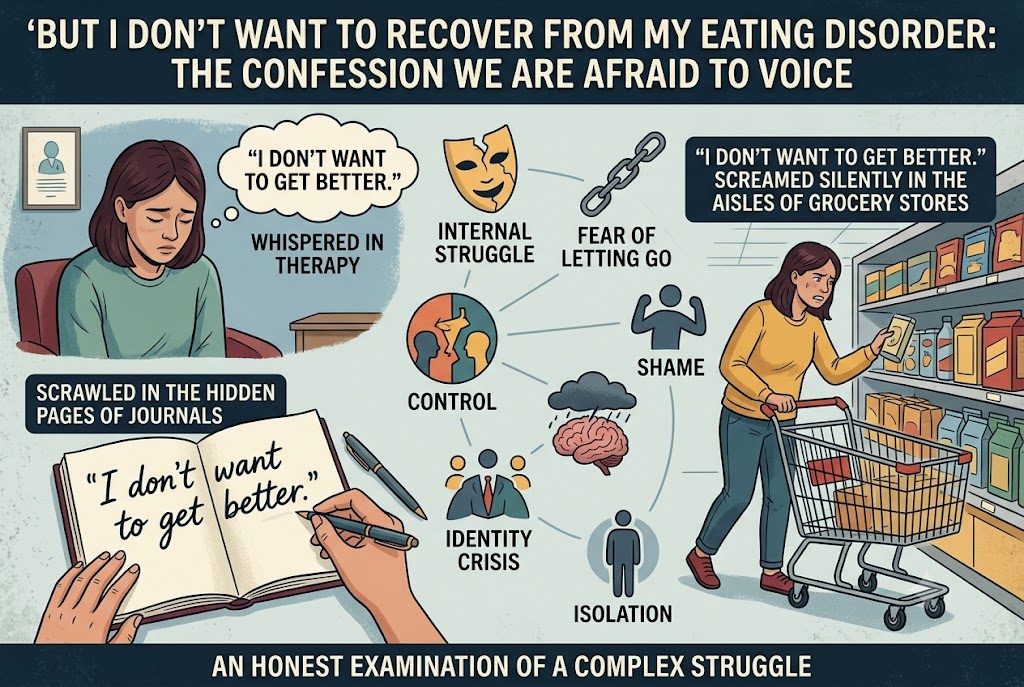
It is a confession whispered in the quiet safety of therapy offices, scrawled in the hidden pages of journals, and screamed silently in the aisles of grocery stores. If you are struggling with an eating disorder and find yourself clinging to it with every ounce of your being, you are not broken. You are not a failure. In fact, you are experiencing one of the most common, painful, and misunderstood aspects of these illnesses: ambivalence.
In a world that paints recovery as a straightforward journey of choosing health over sickness, admitting that you don’t want to let go of your eating disorder can feel like a betrayal. It invites shame, confusion, and frustration from loved ones who wonder, “Why can’t you just eat?” or “Why do you keep doing this to yourself?”
But the truth is much more complex. An eating disorder is rarely just about food, weight, or vanity. It is a coping mechanism, a shield, and a survival strategy. To ask you to simply “recover” is to ask you to lay down your armor in the middle of a battlefield. Let’s explore why you might want to hold onto your eating disorder, and how you can navigate these complex emotions without shame.
Why the Eating Disorder Feels Like a Friend
To anyone looking from the outside, an eating disorder is a destructive, life-threatening monster. But to the person living inside it, the disorder often feels like a savior. To begin moving forward, we must first honor and understand the function that the illness serves in your life. It persists because it is doing a job for you.
1. The Illusion of Absolute Control
Life is inherently unpredictable, chaotic, and often overwhelming. When relationships fail, academic pressures mount, or trauma shatters your sense of safety, your eating disorder offers a micro-universe where you are the absolute ruler. Controlling your food intake, your exercise, or your weight provides an immediate, tangible sense of mastery. It tells you: “No matter how chaotic the world gets, you control this.”
2. The Ultimate Emotional Anesthetic
Eating disorders are incredibly effective at numbing pain. When you are starving, your brain redirects its energy to basic survival, turning down the volume on painful emotions like grief, anxiety, anger, and loneliness. When you binge or purge, the physiological shift can offer a temporary, chemical-fueled release from intense emotional distress. It is a way of coping when you feel you lack the tools to handle the sheer weight of your feelings.
“The eating disorder didn’t come into my life to destroy me; it came to save me from the feelings I wasn’t strong enough to feel.”
3. A Ready-Made Identity
Who are you without your eating disorder? For many, this is the most terrifying question of all. The illness can swallow your personality whole, leaving you with a ready-made identity: the “disciplined” one, the “thin” one, the “sick” one, or the “invisible” one. Letting go of the disorder feels like stepping off a cliff into an abyss of nothingness. The fear of losing your identity is a powerful anchor keeping you anchored in sickness.
The Biology of Resistance: It’s Not Just in Your Head
It is vital to understand that your resistance to recovery is not a moral failing or a lack of willpower. It is deeply wired into your neurobiology. Eating disorders are what psychologists call ego-syntonic. This means the symptoms are aligned with your self-image, values, and goals. Unlike obsessive-compulsive disorder (where the sufferer hates their compulsions), someone with an eating disorder often experiences their behaviors as positive, protective, and desirable.
Furthermore, prolonged starvation, malnutrition, or chaotic eating patterns alter brain chemistry. The brain enters a survival mode that distorts perception, amplifies anxiety, and rigidifies thinking. Your brain literally convinces you that food is the enemy and the eating disorder is your only safe harbor. You are fighting against a hijacked nervous system.
Anatomy of the Fear: What Are We Actually Afraid Of?
When you say, “I don’t want to recover,” what you are often saying is, “I am terrified of what recovery will force me to face.” Let’s unpack the core fears that drive recovery resistance:
- The Fear of Weight Gain and Body Changes: We live in a culture deeply rooted in diet culture and fatphobia. The fear of your body changing is not trivial; it is a fear of losing social currency, facing judgment, and feeling uncomfortable in your own skin.
- The Fear of Feeling: Without the numbing effect of the eating disorder, raw emotions—grief, trauma, inadequacy, anger—will bubble to the surface. Facing them without your primary coping mechanism feels impossible.
- The Fear of Failure: What if you try to recover, give it everything you have, and still fail? Clinging to the disorder can feel safer than risking the vulnerability of trying and falling short.
- The Fear of Being “Normal”: To many, recovery sounds like settling for an average, mundane life where you no longer feel special, unique, or exceptionally disciplined.
The Myth of “100% Ready”
One of the greatest misconceptions about eating disorder recovery is that you have to want it completely before you can start. You might be waiting for a magical morning when you wake up, suddenly free of fear, ready to embrace nourishment and self-love.
That day is not coming. And that is okay.
Recovery does not require 100% willingness. It doesn’t even require 50% willingness. It only requires a tiny, microscopic speck of curiosity. It requires you to look at your life and ask: “Is it possible there is another way to live, even if I can’t see it yet?”
The Concept of Dialectics: Holding Two Truths
In Dialectical Behavior Therapy (DBT), we learn that two seemingly opposite things can be true at the same time. You can practice holding these dual truths without judgment:
“I hate what this eating disorder is doing to my life, AND I am terrified of letting it go.”
“I want to be healthy and free, AND I still want to restrict/purge/binge today.”
Allowing yourself to hold both feelings relieves the immense pressure of having to feel “perfectly motivated.” You are allowed to walk toward recovery kicking, screaming, and crying. You are allowed to do it afraid.
Shift Your Perspective: From “Recovery” to “Experimentation”
If the word “recovery” feels too heavy, too permanent, or too terrifying, throw it out. You do not have to commit to forever right now. Instead, frame your journey as a series of low-stakes experiments.
Step 1: The Cost-Benefit Analysis
Grab a piece of paper and write down honestly what your eating disorder gives you, and what it takes away. Be brutally honest.
- What it gives you: Safety, control, a sense of achievement, numbing.
- What it takes: Your relationships, your physical health, your spontaneity, your focus, your joy, your future.
Look at the list. You don’t have to change anything today, but allow yourself to see the high price you are paying for the safety the disorder promises.
Step 2: Micro-Experiments
Instead of promising to change your entire life, try making tiny, temporary agreements with yourself.
For example: “I will eat this snack today, just to see what happens. If the anxiety is too overwhelming, I can re-evaluate tomorrow.” Or, “I will sit with my feelings for ten minutes before acting on an urge.” Treatment is not about jumping across a canyon; it is about taking one microscopic step at a time.
Who Are You Beyond the Illness?
Your eating disorder has convinced you that it is the most interesting thing about you. It is a lie. The disorder is a thief that has stolen your time, your passions, your quirks, and your dreams, replacing them with calorie counts, weight checks, and rules.
Reclaiming your life means slowly rebuilding the identity that was stolen. Ask yourself questions that have nothing to do with your body or food:
- What did I love doing when I was ten years old?
- What causes, ideas, or hobbies spark my curiosity?
- What kind of friend, partner, or person do I want to be?
- How do I want people to remember me? (Hint: Nobody’s eulogy praises them for maintaining a certain clothing size).
Finding Your “Why” When You Don’t Want to Get Better
If you don’t want to recover for yourself, that is okay for now. Sometimes, we have to borrow motivation from other sources until we can generate our own. Who or what can you find motivation for?
Can you do it for the dog who waits for you to take them on walks you currently have no energy for? Can you do it for the younger sibling who is watching how you treat your body? Can you do it for the future version of you who wants to travel, write a book, build a career, or start a family?
Sometimes, the ultimate “why” is simply the exhaustion of staying the same. The eating disorder promises comfort, but eventually, it delivers only a cold, isolated prison. The pain of staying where you are will eventually exceed the pain of changing.
How to Take the Next Step
If you are standing on the edge of the recovery abyss, feeling intensely resistant, here is how you can gently proceed:
1. Find a Compassionate, Non-Judgmental Team
Work with therapists, dietitians, and doctors who understand the nuance of eating disorder recovery. Tell them honestly: “I don’t want to get better, but I’m here anyway.” A skilled professional will not force you into submission; they will meet you in your ambivalence and help you explore it safely.
2. Practice Harm Reduction
If full recovery feels impossible, focus on harm reduction. How can you make your daily life just 5% safer? Can you take a multivitamin? Can you reduce your purging frequency? Can you eat one safe meal? Small steps protect your body while your mind catches up.
3. Forgive Your Resistance
Stop beating yourself up for wanting to stay sick. Thank your eating disorder for trying to protect you, but gently remind yourself that you are learning new, healthier ways to survive. Self-compassion, not self-flagellation, is the key that unlocks the prison door.
The Beautiful Life Waiting on the Other Side
Choosing recovery does not mean you will never feel anxious, sad, or out of control again. It means you will learn to navigate the storms of life with a clear mind, a nourished body, and a resilient spirit. It means you will get your brain, your laughter, your relationships, and your freedom back.
You don’t have to want to recover today. You just have to be willing to stay in the room, keep breathing, and allow for the slight, beautiful possibility that your life can be so much bigger than your illness.
Dr. Lall Psychology & MindCare Services
Promotional Video : https://www.youtube.com/watch?v=T8OQ2YwKoe0
Quantum Psychology Experiential Program
Admission Form Available at : https://www.amazonauthor.in
YouTube Subscribe : https://www.youtube.com/@drlallpsychology
Linkedin Connect : https://www.linkedin.com/in/drlallpsychology
Linkedin Follow : https://www.linkedin.com/company/drlallpsychology
WhatsApp Channel : https://whatsapp.com/channel/0029VbDEEVb4o7qRCY6UEp38
To Buy Books – by – Dr. Solomon Lall 3-PhDs : Author, Mind Research Scientist, Grahastya YogRishi, Sr. Consultant : Emotional Health & Mental Wellness.
Most Popular, Acclaimed and Renowned Published Book, Now on Amazon book Stores throughout the world
Author Page : https://www.amazon.com/author/drlall
1) https://a.co/d/09tTuF6s : Quantum Psychology: Freedom from Painful Mind Matters
2) https://a.co/d/045dAL7q : Mental Hygiene is The New Dental Hygiene: The Science & Art of Keeping your Mind Clean
3) https://a.co/d/02a2WXGT : Menopause – The Mindful Pause: Redefining Menopause Through Mental Hygiene, Science, and Self-Discovery
4) https://a.co/d/01s1ae3A : Sanātan Psychology: The Science & Wisdom of Ancient Bhārata
5) https://a.co/d/0j3WmYTP : Quantum Biology: Healing the Mind With Secret Science
6) https://a.co/d/0dOByGYF : 1-3 : Quantum BioHack: The Secrets of Energy, Vibrations, Frequency & The Rhythmic Healing
7) https://a.co/d/0cPAiaQg : 2-3 : Quantum BioHack: The Secrets of Energy, Vibrations, Frequency & The Rhythmic Healing
8) https://a.co/d/0dnGlHR3 : 3-3 : Quantum BioHack: The Secrets of Energy, Vibrations, Frequency & The Rhythmic Healing
9) https://a.co/d/02XShiQh : Wired For JOY: A science-backed, heart-centered exploration of your happy hormones
10) https://a.co/d/05uD1fnf : Grahastya Yoga: The Supreme Yoga for Everyone
11) https://a.co/d/0eZn6yPF : Quantum Parenting: Parenting in the AI Age
12) https://a.co/d/03ybLa0Q : The CODD Problem : Cortisol Overload and Dopamine Deficiency.
13) https://a.co/d/00WOJjAr : Where is Your Mind Located: The Bhoot Blueprint
14) https://a.co/d/0hS1J6xK : Beyond Maya: Awakening the Mind’s Secret Science
For School & University Mental Wellness Partnerships :
For Schools – Download Flyer – (Very Popular) : https://drive.google.com/file/d/1qJ8uoDlHK7Pr0iXmID5oMFv-DkxbzV0H
For Campus – Campus Influencer Program –
https://drive.google.com/file/d/1UBFaSfoGQGBOg86G0uIgr4SUigg3n0pF
send Your Resume to mindlabs@authordrlall.com
To Check all Ongoing Job Opportunities. Study the Job Descriptions from our Associates Linked Posts :
: Social Media Content Creator – All over India. : https://www.linkedin.com/jobs/view/4435409715/
: University, School & Campus Influencer – All over India : https://www.linkedin.com/jobs/view/4433157584/
: Associate Psychologist – All over India.
https://www.linkedin.com/jobs/view/4436464924
Dr. Solomon Lall Psychology & MindCare Services is a premier emotional health and mental wellness practice delivering trusted, evidence-based psychological care. Led by Dr. Solomon Lall (23+ years experience, 2,500+ clients, 12,500+ therapy hours), the practice blends ancient Vedic mental body yogic concepts with modern mind sciences.
We provide holistic, tailored online services worldwide using a proprietary Quantum Psychology Blueprint and Quantum Biohack Framework. Specialized programs address emotional discovery, recovery, loneliness, pain, and age-specific mental health needs for individuals and corporates.
https://drlallpsychology.com
https://drsolomonlall.com
https://lalldr.com
https://whereismytherapy.com
https://leadpsychologist.com