
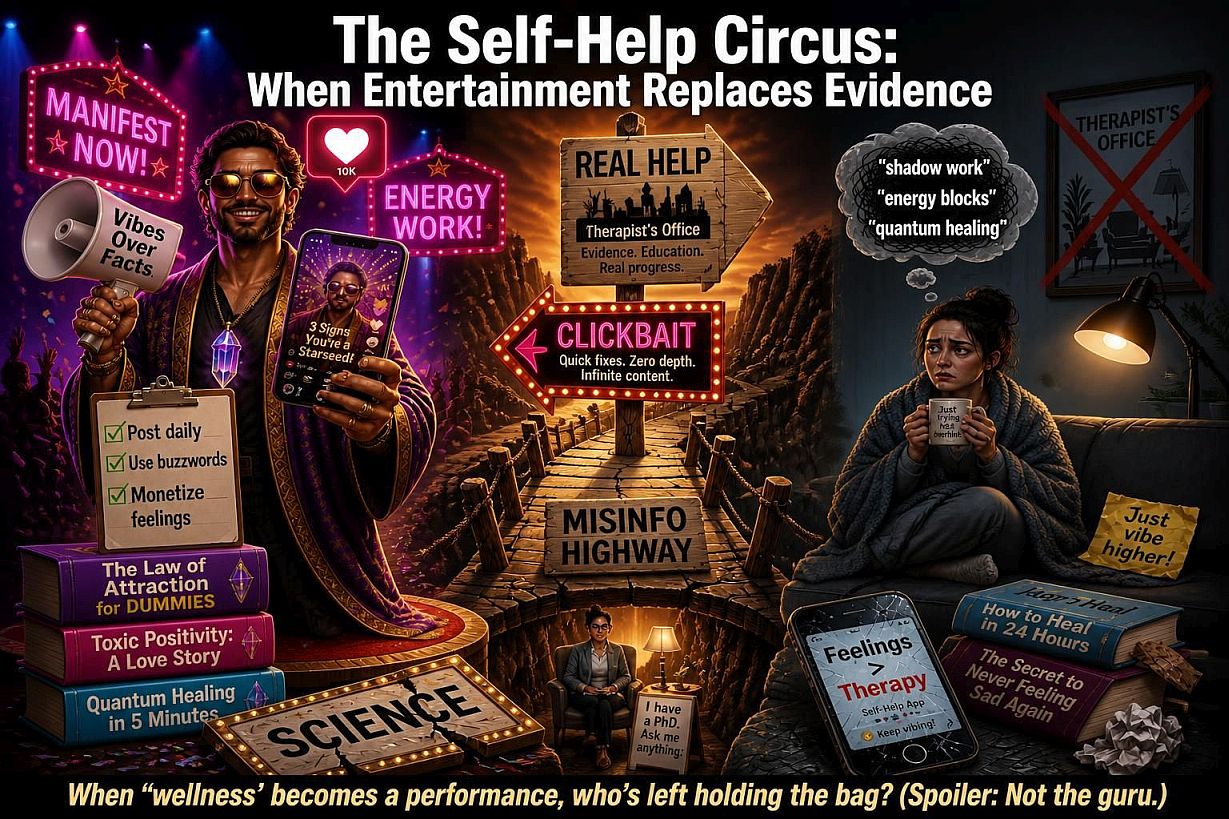
The Self-Help Circus: When Entertainment Replaces Evidence
Walk into any scrolling session—morning commute, late-night couch time, lunch break—and you’ll likely encounter the same performance, dressed up as healing. A smiling influencer frames their advice like magic. A cheerful montage sells “breakthrough” in under sixty seconds. A neon chorus promises that if you just change your mindset the right way, reality will rearrange itself.
It feels safe because it’s packaged as comfort. It feels empowering because it’s enthusiastic. It feels personal because it uses your language—your fears, your hopes, your identity. But beneath the sparkle is a system designed less to help people navigate life than to keep them watching. And when entertainment begins to replace evidence, the harm isn’t hypothetical. It’s predictable.
This trend—call it wellness content, spiritual branding, “manifesting” culture, or motivation-as-medicine—has evolved into a self-help circus. The guru talks, the crowd claps, and the consequences bounce down the wobbly bridge labeled “Misinfo Highway.” In the real world, though, there’s no stage manager. No safety net. People carry these messages into therapy, workplaces, relationships, pregnancies, chronic illness, addiction recovery, grief, disability, and parenting. They make decisions with their money, their time, and sometimes their bodies. And the cost of bad guidance, delayed treatment, and emotional manipulation can be devastating.
Entertainment is not neutral—it’s an engine
The entertainment-first self-help influencer doesn’t just share information. They run a content machine. The machine optimizes for engagement: quick hooks, dramatic before-and-after narratives, simplified causes, and universal “signs” that let the viewer feel seen immediately. It rewards certainty. It punishes nuance. It turns uncertainty into a waiting room where the next video will “unlock” what the last one couldn’t explain.
That’s the central danger for the general population: most people don’t consume these posts as hypotheses. They consume them as instructions.
When entertainment rules the format, evidence loses. Evidence is slower: it comes with probabilities, limitations, and the boring honesty that results vary. Entertainment is faster: it compresses complexity into a takeaway you can repeat at dinner. Evidence asks, “What do we know and how sure are we?” Entertainment asks, “How can you feel special right now?”
And once someone learns to respond emotionally to content, they start to treat emotion as proof.
The performance creates a false hierarchy: feelings > facts
Most of this content doesn’t begin with “We tested this” or “Here’s the research landscape.” It begins with “Here’s how it works.” Not “it might” or “some people find” or “this is worth discussing with a professional.” Instead, the content implies an unseen authority: the guru’s tone, the certainty of the delivery, the spiritual certainty of phrases, the implied expertise of a glowing background and a carefully curated story.
Then it layers in a psychological shortcut: “If you feel it, it’s true.”
That shortcut is powerful. It’s also dangerous. Feelings are real, but they’re not data. Many harmful patterns start with emotional plausibility:
- You feel hopeful, so the claim must be beneficial.
- You feel guilty after not “doing it right,” so the problem is your character.
- You feel confused, so more content must be the missing ingredient.
- You feel relief after buying the product, so the advice must be correct.
- You feel validated as “chosen,” so reality must align with the narrative.
None of these connections are scientifically reliable. Yet the content repeatedly trains viewers to treat them as validation.
Over time, the person doesn’t just adopt a belief. They adopt a method: disregard contradictory evidence, interpret setbacks as personal failure, and assume improvement will arrive once they purchase the next step.
The “guru economy” profits from uncertainty
Here’s a hard truth: many creators aren’t selling tools—they’re selling access. They sell the feeling that the audience is on the inside track. They sell the next revelation. They sell the belonging that comes from being part of a tribe that understands the “real story.”
And when the advice is vague enough to fit any outcome, it becomes unfalsifiable. If you improve, the guru was right. If you don’t, you didn’t apply it correctly—or you’re blocked, resistant, or not vibrating high enough. This flexibility is commercially convenient and psychologically corrosive. It protects the brand from accountability.
The harm comes in several forms:
Financial exploitation: Products, courses, “sessions,” subscriptions, and “energy work” can accumulate quickly. If someone is already stressed, lonely, or overwhelmed, the cost may be justified as “self-investment.” But if the guidance is not grounded in reliable practice, the money becomes an accelerant for desperation.
Time exploitation: A viewer who’s drowning in work stress, grief, depression, or trauma may be encouraged to replace practical steps with endless self-interpretation. Instead of addressing what’s actually harming them—unsafe living conditions, lack of support, medical issues, relationship abuse—they invest time in rituals and reframes that provide temporary relief but delay durable solutions.
Authority displacement: The most effective exploitation isn’t always the product; it’s the replacement of competent authority with charismatic authority. When people trade their physician, therapist, teacher, or coach for a content creator, the safety and pacing of care collapses.
Entertainment platforms make this easy because the barrier to entry is low and distribution is automated. The result is a marketplace where the loudest, most confident voice can outcompete the most cautious evidence.
The content trains people to self-diagnose and self-blame
A huge portion of wellness entertainment depends on interpretive frameworks that can explain anything. That may feel comforting at first—until you realize it means the framework can explain away everything that goes wrong.
When your pain is described as “energy blocks,” your anxiety as “stuck patterns,” your depression as “resistance,” or your failure to heal as “vibration misalignment,” you’re not just learning a new story. You’re being assigned responsibility for outcomes that may require medical and psychological intervention.
Even well-intentioned people can suffer when they are told, implicitly or explicitly:
- “If you don’t recover, it’s because you weren’t ready.”
- “If you feel worse, you’re not focusing correctly.”
- “If you’re still struggling, it’s because you’re doing it wrong.”
- “If others don’t understand, they’re not awakened.”
These messages don’t simply ignore complexity—they weaponize it. They turn the viewer’s suffering into a moral puzzle. They turn care into compliance. They make seeking help feel like admission of incompetence rather than a normal act of survival.
For a population at large—people without clinical training, without the ability to evaluate claims critically—this is a widespread risk factor.
The “evidence vacuum” leaves people without guardrails
Evidence-based guidance comes with guardrails:
- It helps people differentiate between what’s likely, possible, and improbable.
- It encourages screening for red flags.
- It emphasizes “if X, then see a professional.”
- It respects the limits of what self-help can do.
- It avoids absolute claims about outcomes.
Entertainment content rarely provides guardrails because guardrails slow down sharing. Complex caution doesn’t perform well in thumbnails. Nuance doesn’t fit into a caption. And “see a clinician if symptoms persist” doesn’t create the same emotional payoff as “you’re going to transform today.”
So many viewers end up in an evidence vacuum where harmful myths fill the space.
That vacuum can be especially dangerous for people with:
- serious mental health conditions,
- chronic illnesses,
- eating disorders,
- substance use disorders,
- postpartum complications,
- neurologic symptoms,
- trauma that requires specialized treatment,
- domestic violence or coercive relationships.
When someone needs timely care, entertainment can become a delay mechanism. Not because the content explicitly says “don’t seek help,” but because it distracts, reinterprets, and reorders priorities until the moment for intervention passes.
The promise of instant transformation encourages risky decisions
One reason these trends feel seductive is the fantasy of speed. “Manifest in 24 hours.” “Heal in five minutes.” “Release your blocks now.” Such claims compress time, making viewers believe they can bypass normal processes: grief cycles, bodily healing, therapy work, behavioral change.
But human health is not a product launch. Many conditions require sustained intervention, gradual behavioral shifts, or medical management. When entertainment promises shortcuts, it nudges people toward:
- postponing diagnoses,
- stopping effective treatments prematurely,
- rejecting structured therapeutic plans,
- chasing intensives rather than consistent care,
- replacing support systems with solitary “inner work.”
Even if a viewer doesn’t fully abandon medical help, the content can still produce harm by eroding adherence: “I’m doing the real work now; the old tools were wrong.” That’s how progress becomes inconsistent and recovery becomes harder.
The language of spirituality can become a cover for manipulation
There’s a common tactic in the self-help circus: borrow the cultural authority of spirituality or therapy, then blend it with salesmanship. Terms like “energy,” “alignment,” “shadow work,” “quantum,” “vibration,” and “reprogramming” can sound sophisticated enough to bypass skepticism.
But the sophistication is often performative. Words create an aura of depth while avoiding measurable claims.
Manipulation doesn’t always look like a villain twirling a mustache. Sometimes it looks like:
- “You’re special, but only if you understand this framework.”
- “Other people are asleep; you’re awake, so you’re responsible for your healing.”
- “Your pain is a lesson—buy the lesson.”
- “If you love me, you’ll act now.”
- “I’m not here to be understood; I’m here to awaken you.”
- “Your intuition is your compass—except when it tells you to get help.”
This kind of rhetorical structure turns dissent into betrayal. It turns boundaries into “blockages.” It turns caution into “fear.”
For a general audience, that’s a high-risk setup. People don’t need to be gullible; they just need to be vulnerable, tired, and hopeful—the exact conditions these platforms learn to monetize.
Community can be a genuine comfort—and still be harmful
Not all wellness communities are predatory. Many are supportive, creative, and meaningful. Some groups genuinely help people connect and cope.
The danger isn’t the existence of community. The danger is when community becomes a substitute for competence.
A community can cheer you through a hard week while also reinforcing misinformation that steers you away from care. The support can coexist with manipulation. In fact, it often does.
When a creator’s worldview becomes the dominant lens, disagreement becomes “negativity.” Alternative explanations become “limiting beliefs.” The person’s lived experience becomes proof of doctrine rather than a starting point for careful inquiry.
So the harm may be subtle: not yelling “therapy is wrong,” but gently training the person to distrust the very professionals who can help them most.
What’s at stake: the difference between coping and care
Self-help entertainment can offer coping—temporary emotional regulation, meaning-making, encouragement, and a sense of control. Those are not nothing.
But care is different. Care involves assessment, appropriate treatment, and follow-through. Care includes acknowledging uncertainty without turning uncertainty into sales opportunity. Care respects complexity.
The self-help circus tends to blur the boundary between coping and care. It sells “wellness” as if it were equivalent to medical or clinical support. It sells confidence as if it were competence.
That blur is the core danger for a population at large. Most people aren’t trained to tell when coping advice becomes a substitute for care. Many people are simply trying to survive their lives—and they deserve better than a performance.
How entertainment-first wellness becomes a public health issue
At scale, these trends can create patterns:
- People delay seeking evidence-based help because they’re waiting to “manifest” outcomes.
- People develop shame around symptoms they can’t control.
- People spend money that could fund actual treatment.
- People adopt frameworks that reduce their willingness to consider biological, psychological, or social causes.
- People become easy targets for scams that exploit the same narrative structures.
When misinformation spreads faster than evidence, society becomes more brittle. People become less able to evaluate claims. Trust becomes misdirected. And suffering becomes harder to address because the path to effective help gets crowded out by content.
It’s not dramatic in a single story. It’s systemic.
The “anti-guru” truth: competence is less glamorous, but safer
The best helpers don’t rely on neon spectacle. They don’t need to dominate the room to be credible. Evidence-based practitioners may be less entertaining, but they are disciplined.
They ask questions. They check red flags. They recommend what’s proportionate. They honor limits. They don’t demand that your pain fit their worldview. They don’t treat setbacks as proof of your inadequacy.
In a healthy culture of help, the viewer is not a customer of emotional certainty. The viewer is a person building resilience through tools that can be evaluated, adapted, and supported by real-world outcomes.
That’s why “wellness” becomes dangerous when it turns into performance: when the goal is not healing but spectacle, when the metric is not improved functioning but engagement, when the promise is not care but belief.
A practical way to protect yourself (without becoming cynical)
If you consume any self-help content—entertainment or otherwise—you don’t need to become hostile to optimism. You need to restore discernment.
Here are the simplest guardrails:
- Demand falsifiability: If a claim can explain every outcome, it may be unfalsifiable. Ask what evidence would change the creator’s mind.
- Watch for guilt tactics: If the advice implies your suffering is your fault for not “doing it right,” treat it as a warning sign.
- Check for red-flag avoidance: If a creator discourages professional care or makes “delay” sound empowering, step back.
- Separate coping from treatment: Emotional reframes and rituals can soothe. They should not replace medical/clinical support for serious symptoms.
- Look for specificity: Evidence-based guidance tends to be specific about mechanisms, timelines, and limitations.
- Prefer collaborative advice: Real help often involves professionals, accountability, and measurable progress—rather than isolated belief rituals.
The goal isn’t to “win” against the guru. The goal is to avoid letting entertainment steer your life decisions.
Conclusion: the show ends, but the consequences don’t
The self-help circus is captivating because it offers something most people crave: meaning, empowerment, and a sense that suffering can be transformed. But when entertainment replaces evidence, the transformation becomes cosmetic. Confidence becomes a substitute for competence. Belief becomes a product. And the person seeking help becomes the backstage crew—cleaning up the mess created by the performance.
If you’ve ever watched a wellness trend promise relief and deliver confusion instead, you already know the feeling: relief quickly turns into self-doubt, doubt turns into more content, and more content turns into a loop that keeps you watching while your real needs wait outside the tent.
Real help doesn’t need confetti to work. It needs integrity, evidence, and the humility to say: some things are complicated, and sometimes the safest next step is professional care—not another act.
Dr. Lall Psychology & MindCare Services
Promotional Video : https://www.youtube.com/watch?v=T8OQ2YwKoe0
Quantum Psychology Experiential Program
Admission Form Available at : https://www.amazonauthor.in
YouTube Subscribe : https://www.youtube.com/@drlallpsychology
Linkedin Connect : https://www.linkedin.com/in/drlallpsychology
Linkedin Follow : https://www.linkedin.com/company/drlallpsychology
WhatsApp Channel : https://whatsapp.com/channel/0029VbDEEVb4o7qRCY6UEp38
To Buy Books – by – Dr. Solomon Lall 3-PhDs : Author, Mind Research Scientist, Grahastya YogRishi, Sr. Consultant : Emotional Health & Mental Wellness.
Most Popular, Acclaimed and Renowned Published Book, Now on Amazon book Stores throughout the world
Author Page : https://www.amazon.com/author/drlall
1) https://a.co/d/09tTuF6s : Quantum Psychology: Freedom from Painful Mind Matters
2) https://a.co/d/045dAL7q : Mental Hygiene is The New Dental Hygiene: The Science & Art of Keeping your Mind Clean
3) https://a.co/d/02a2WXGT : Menopause – The Mindful Pause: Redefining Menopause Through Mental Hygiene, Science, and Self-Discovery
4) https://a.co/d/01s1ae3A : Sanātan Psychology: The Science & Wisdom of Ancient Bhārata
5) https://a.co/d/0j3WmYTP : Quantum Biology: Healing the Mind With Secret Science
6) https://a.co/d/0dOByGYF : 1-3 : Quantum BioHack: The Secrets of Energy, Vibrations, Frequency & The Rhythmic Healing
7) https://a.co/d/0cPAiaQg : 2-3 : Quantum BioHack: The Secrets of Energy, Vibrations, Frequency & The Rhythmic Healing
8) https://a.co/d/0dnGlHR3 : 3-3 : Quantum BioHack: The Secrets of Energy, Vibrations, Frequency & The Rhythmic Healing
9) https://a.co/d/02XShiQh : Wired For JOY: A science-backed, heart-centered exploration of your happy hormones
10) https://a.co/d/05uD1fnf : Grahastya Yoga: The Supreme Yoga for Everyone
11) https://a.co/d/0eZn6yPF : Quantum Parenting: Parenting in the AI Age
12) https://a.co/d/03ybLa0Q : The CODD Problem : Cortisol Overload and Dopamine Deficiency.
13) https://a.co/d/00WOJjAr : Where is Your Mind Located: The Bhoot Blueprint
14) https://a.co/d/0hS1J6xK : Beyond Maya: Awakening the Mind’s Secret Science
For School & University Mental Wellness Partnerships :
For Schools – Download Flyer – (Very Popular) : https://drive.google.com/file/d/1qJ8uoDlHK7Pr0iXmID5oMFv-DkxbzV0H
For Campus – Campus Influencer Program –
https://drive.google.com/file/d/1UBFaSfoGQGBOg86G0uIgr4SUigg3n0pF
send Your Resume to mindlabs@authordrlall.com
To Check all Ongoing Job Opportunities. Study the Job Descriptions from our Associates Linked Posts :
: Social Media Content Creator – All over India. : https://www.linkedin.com/jobs/view/4435409715/
: University, School & Campus Influencer – All over India : https://www.linkedin.com/jobs/view/4433157584/
: Associate Psychologist – All over India.
https://www.linkedin.com/jobs/view/4436464924
Dr. Solomon Lall Psychology & MindCare Services is a premier emotional health and mental wellness practice delivering trusted, evidence-based psychological care. Led by Dr. Solomon Lall (23+ years experience, 2,500+ clients, 12,500+ therapy hours), the practice blends ancient Vedic mental body yogic concepts with modern mind sciences.
We provide holistic, tailored online services worldwide using a proprietary Quantum Psychology Blueprint and Quantum Biohack Framework. Specialized programs address emotional discovery, recovery, loneliness, pain, and age-specific mental health needs for individuals and corporates.
https://drlallpsychology.com
https://drsolomonlall.com
https://lalldr.com
https://whereismytherapy.com
https://leadpsychologist.com