
The Silent Fuel: Demystifying Big ‘T’ and Little ‘t’ Trauma in Eating Disorders 🧠🍽️
🔍 The Anatomy of Trauma: Defining Big ‘T’ vs. Little ‘t’
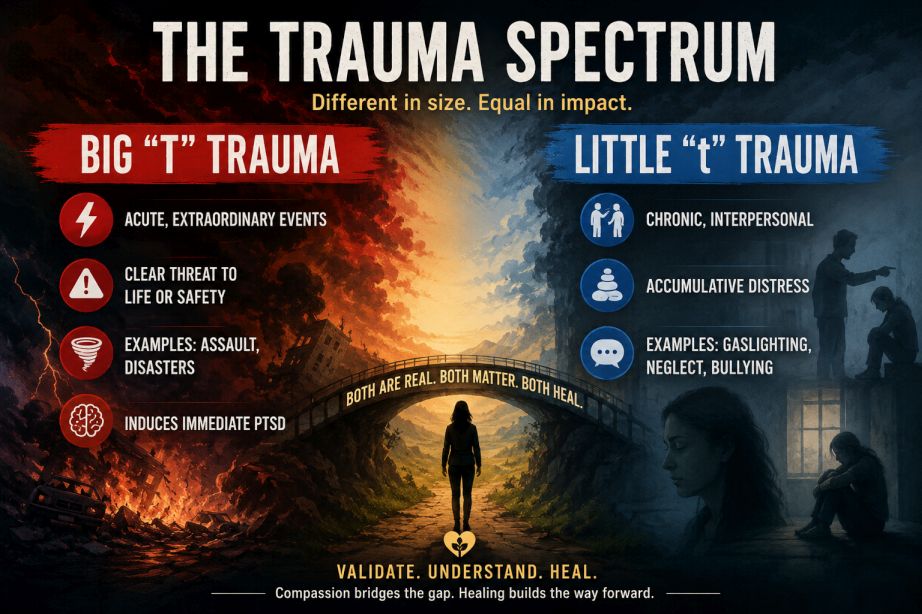
+-----------------------------------------------------------------+

|                       THE TRAUMA SPECTRUM                       |
+-----------------------------------------------------------------+

| BIG "T" TRAUMA                      | LITTLE "t" TRAUMA         |
| - Acute, extraordinary events       | - Chronic, interpersonal  |
| - Clear threat to life or safety    | - Accumulative distress   |
| - Examples: Assault, disasters      | - Examples: Gaslighting,  |
| - Induces immediate PTSD            |   neglect, bullying       |
+-----------------------------------------------------------------+
🌋 Big ‘T’ Trauma: The Sudden Earthquake
- Surviving a catastrophic natural disaster.
- Experiencing physical or sexual assault.
- Witnessing a sudden, violent death.
- Being involved in a high-impact car accident.
🌊 Little ‘t’ Trauma: The Invisible Tide
- Growing up with an emotionally cold or narcissistic parent.
- Enduring persistent childhood bullying or social isolation.
- Navigating financial instability or chronic systemic discrimination.
- Experiencing a messy, high-conflict parental divorce.
⚡ The Neurobiological Mirror: How Both Traumas Shape the Brain
[ Unprocessed Trauma ] ──> [ Chronic Amygdala Highjack ] ──> [ Loss of Internal Safety ]
                                                                      │
                                                                      ▼
[ Somatic Numbing ] <── [ Disordered Behavior ] <── [ Desperate Need for Control ]
- The Amygdala Hijack: The amygdala—the brain’s alarm system—stays constantly turned “ON.” The individual lives in a perpetual state of hyper-vigilance, expecting disaster or rejection around every corner.
- Prefrontal Cortex Shutdown: The prefrontal cortex—the seat of logical reasoning and emotional regulation—struggles to stay online. The person feels flooded by emotions they can neither name nor tolerate.
- The Loss of Interoception: When the internal landscape becomes a war zone of anxiety, shame, and panic, the brain disconnects from the body to survive. The person loses interoception—the ability to accurately sense internal bodily cues like heartbeat, anxiety, or biological hunger and fullness.
📊 The Eating Disorder Connection: Two Paths to One Destination
| Trauma Category | Core Psychological Wound | Resulting Disordered Eating Function |
|---|---|---|
| Big “T” Trauma (e.g., Sexual Assault) | Somatic Violation & Total Loss of Control | Anorexia Spectrum: Changing the body’s shape to become desexualized, small, invisible, or hyper-disciplined to prevent future assault. |
| Big “T” Trauma (e.g., Physical Abuse) | Extreme Terror & Physical Overwhelm | Bulimia Spectrum: Using the intense, biological rush of binging to numb terror, followed by the purge to violently expel the felt sense of danger. |
| Little “t” Trauma (e.g., Emotional Neglect) | “I am invisible, empty, and completely unloved.” | Binge Eating Disorder (BED): Using food as a reliable proxy for warmth, presence, and immediate emotional comfort to fill a structural void. |
| Little “t” Trauma (e.g., Academic Perfectionism) | “I am only worthy of love if I achieve flawless execution.” | Orthorexia / Restrictive Eating: Translating the chaotic pressure to be perfect into an immaculate, hyper-controlled diet. |
🔓 Breaking the Cycle: Healing the Trauma Behind the Food
1. Radically Validate Your Little “t” Traumas
2. Move from Cognitive Talking to Somatic Feeling
3. De-Weaponize the Eating Disorder
🌟 Final Thoughts: Your Body is Ready to Call a Truce
+-----------------------------------------------------------------+

|                    A COMPASSIONATE TRUCE                        |
+-----------------------------------------------------------------+

|  "My eating disorder was the bridge that carried me across      |
|   the storms of my past. I honor its protective intent.         |
|   But I am safe now. I am learning new ways to hold my pain.     |
|   I can lay down my shield. I am ready to heal."                |
+-----------------------------------------------------------------+
Dr. Lall Psychology & MindCare Services
Promotional Video : https://www.youtube.com/watch?v=T8OQ2YwKoe0
Quantum Psychology Experiential Program
Admission Form Available at : https://www.amazonauthor.in
YouTube Subscribe : https://www.youtube.com/@drlallpsychology
Linkedin Connect : https://www.linkedin.com/in/drlallpsychology
Linkedin Follow : https://www.linkedin.com/company/drlallpsychology
WhatsApp Channel : https://whatsapp.com/channel/0029VbDEEVb4o7qRCY6UEp38
To Buy Books – by – Dr. Solomon Lall 3-PhDs : Author, Mind Research Scientist, Grahastya YogRishi, Sr. Consultant : Emotional Health & Mental Wellness.
Most Popular, Acclaimed and Renowned Published Book, Now on Amazon book Stores throughout the world
Author Page : https://www.amazon.com/author/drlall
1) https://a.co/d/09tTuF6s : Quantum Psychology: Freedom from Painful Mind Matters
2) https://a.co/d/045dAL7q : Mental Hygiene is The New Dental Hygiene: The Science & Art of Keeping your Mind Clean
3) https://a.co/d/02a2WXGT : Menopause – The Mindful Pause: Redefining Menopause Through Mental Hygiene, Science, and Self-Discovery
4) https://a.co/d/01s1ae3A : Sanātan Psychology: The Science & Wisdom of Ancient Bhārata
5) https://a.co/d/0j3WmYTP : Quantum Biology: Healing the Mind With Secret Science
6) https://a.co/d/0dOByGYF : 1-3 : Quantum BioHack: The Secrets of Energy, Vibrations, Frequency & The Rhythmic Healing
7) https://a.co/d/0cPAiaQg : 2-3 : Quantum BioHack: The Secrets of Energy, Vibrations, Frequency & The Rhythmic Healing
8) https://a.co/d/0dnGlHR3 : 3-3 : Quantum BioHack: The Secrets of Energy, Vibrations, Frequency & The Rhythmic Healing
9) https://a.co/d/02XShiQh : Wired For JOY: A science-backed, heart-centered exploration of your happy hormones
10) https://a.co/d/05uD1fnf : Grahastya Yoga: The Supreme Yoga for Everyone
11) https://a.co/d/0eZn6yPF : Quantum Parenting: Parenting in the AI Age
12) https://a.co/d/03ybLa0Q : The CODD Problem : Cortisol Overload and Dopamine Deficiency.
13) https://a.co/d/00WOJjAr : Where is Your Mind Located: The Bhoot Blueprint
14) https://a.co/d/0hS1J6xK : Beyond Maya: Awakening the Mind’s Secret Science
For School & University Mental Wellness Partnerships :
For Schools – Download Flyer – (Very Popular) : https://drive.google.com/file/d/1qJ8uoDlHK7Pr0iXmID5oMFv-DkxbzV0H
For Campus – Campus Influencer Program –
https://drive.google.com/file/d/1UBFaSfoGQGBOg86G0uIgr4SUigg3n0pF
send Your Resume to mindlabs@authordrlall.com
To Check all Ongoing Job Opportunities. Study the Job Descriptions from our Associates Linked Posts :
: Social Media Content Creator – All over India. : https://www.linkedin.com/jobs/view/4435409715/
: University, School & Campus Influencer – All over India : https://www.linkedin.com/jobs/view/4433157584/
: Associate Psychologist – All over India.
https://www.linkedin.com/jobs/view/4436464924
Dr. Solomon Lall Psychology & MindCare Services is a premier emotional health and mental wellness practice delivering trusted, evidence-based psychological care. Led by Dr. Solomon Lall (23+ years experience, 2,500+ clients, 12,500+ therapy hours), the practice blends ancient Vedic mental body yogic concepts with modern mind sciences.
We provide holistic, tailored online services worldwide using a proprietary Quantum Psychology Blueprint and Quantum Biohack Framework. Specialized programs address emotional discovery, recovery, loneliness, pain, and age-specific mental health needs for individuals and corporates.
https://drlallpsychology.com
https://drsolomonlall.com
https://lalldr.com
https://whereismytherapy.com
https://leadpsychologist.com