
The Art of Friction: Why Your Mistakes Are the Only Proof That You are Growing
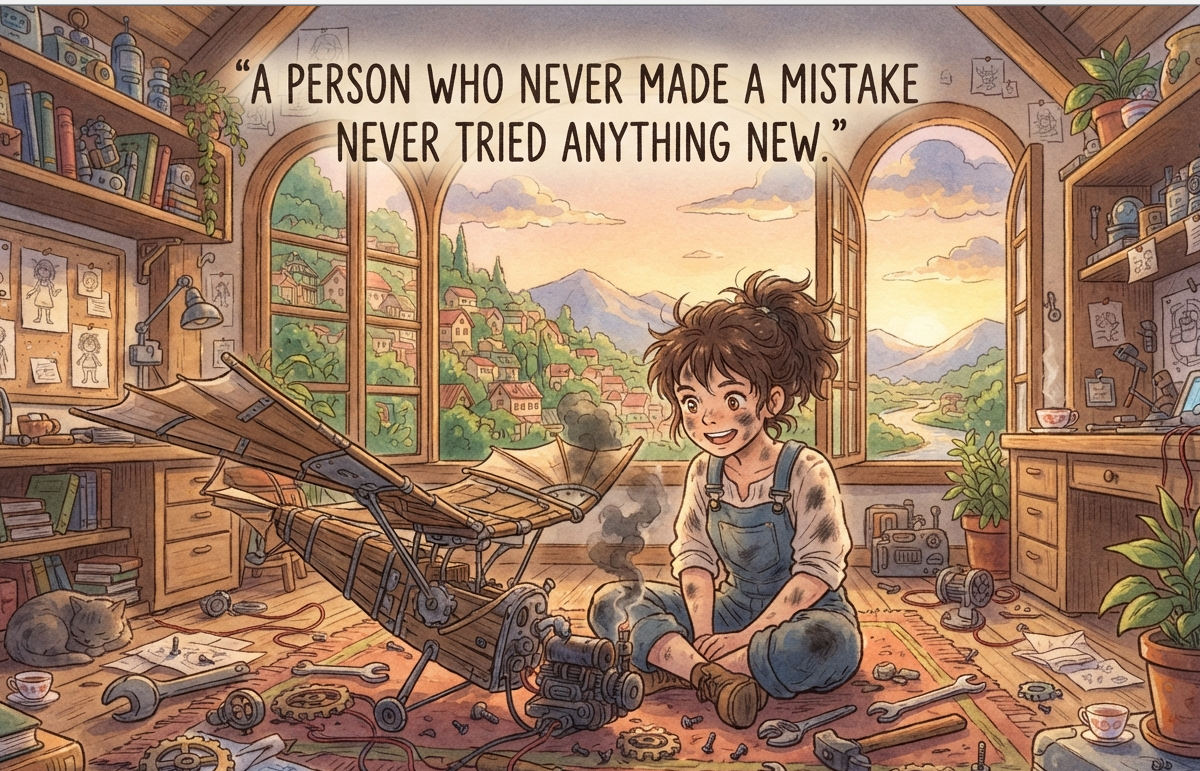
We live in a culture obsessed with the polished end product. We scroll through curated social media feeds, read glowing LinkedIn updates about multi-million dollar acquisitions, and admire the seamless lives of high achievers. But in this relentless pursuit of optimization, we have forgotten a fundamental law of human progress: perfection is the enemy of initiation. Decades ago, Albert Einstein famously observed, “A person who never made a mistake never tried anything new.” This isn’t just a comforting platitude to throw at someone after a bad day at the office. It is a precise, scientific diagnostic of human potential. To attempt anything novel—whether starting a business, learning an instrument, changing careers, or setting a personal boundary—is to step into a zone of high friction. Where there is friction, there will be heat, and occasionally, things will burn. This comprehensive guide explores the deep psychology of failure, the evolutionary cost of playing it safe, and how you can transform your relationship with errors to unlock a life of genuine innovation and growth.The Comfort Zone Trap: The Psychology of the Untried Life
Why do we fear making mistakes so deeply? To understand this, we have to look at how our brains are wired. From an evolutionary standpoint, the unknown was dangerous. For our ancestors, trying a new path through the forest or tasting an unfamiliar berry could result in death. Survival favored the predictable. In modern society, while the physical threat of the unknown has largely evaporated, our brains still process intellectual, social, and professional risks through the same ancient survival filters. When you contemplate launching a new project or speaking up in a high-stakes meeting, your amygdala reacts as if you are facing a physical predator.The Fixed Mindset vs. The Growth Mindset
Psychologist Carol Dweck’s groundbreaking research on mindsets explains this phenomenon beautifully. She categorizes individuals into two distinct groups:- The Fixed Mindset: Believes that intelligence, talent, and creative ability are static givens. In this paradigm, making a mistake is a catastrophic indictment of your core identity. If you fail, it means you are a failure.
- The Growth Mindset: Views challenges and errors not as a verdict on their intelligence, but as springboard for growth and stretching existing capabilities. For these individuals, a mistake is simply data.
“The only real mistake is the one from which we learn nothing.” — Henry Ford
Why Safety is the Riskiest Strategy of All
In a rapidly changing economic and cultural landscape, the definition of “safety” has fundamentally shifted. Trying nothing new is no longer a defense mechanism; it is a guarantee of obsolescence. Consider the corporate giants of the past who prioritized preservation over experimentation—Kodak, Blockbuster, and Nokia. Their mistake wasn’t making too many errors; their fatal mistake was trying to make none at all by clinging to outdated models. On an individual level, the cost of an “error-free” life is stagnation. When you refuse to try new things because you might look foolish, you pay a heavy price in the form of:1. Cognitive Shrinkage
Our brains possess neuroplasticity—the ability to reorganize itself by forming new neural connections throughout life. However, neuroplasticity is only triggered when we encounter novelty, difficulty, and yes, cognitive dissonance. Repeating the same tasks every day keeps your brain on autopilot, accelerating cognitive decline over time.2. Regret Accumulation
Palliative care studies consistently show that on their deathbeds, people rarely regret the mistakes they made while trying to chase a dream. Instead, they are haunted by the “ghosts of the untried”—the books unwritten, the businesses unstarted, and the words left unsaid.Historical Proof: How Mistakes Built the Modern World
If you trace back almost every major scientific breakthrough, artistic masterpiece, or commercial revolution, you will find a trail of spectacular, often embarrassing errors. The history of innovation is not a straight line; it is a chaotic zig-zag of happy accidents and persistent course corrections.- Sir Alexander Fleming and the Messy Lab: In 1928, Fleming returned to his cluttered laboratory after a vacation to find that a strange mold had contaminated one of his Petri dishes. Instead of simply throwing it away in embarrassment, he studied it. That mistake led to the discovery of penicillin, saving hundreds of millions of lives.
- James Dyson’s 5,126 Failures: It took James Dyson 15 years and 5,127 failed prototypes to create his revolutionary bagless vacuum cleaner. He spent his entire savings and went deep into debt. Dyson didn’t view those 5,126 attempts as failures; he viewed them as a process of elimination.
- The Post-it Note Accident: Dr. Spencer Silver, a scientist at 3M, was trying to develop a super-strong adhesive. Instead, he accidentally created a weak, pressure-sensitive adhesive that stuck lightly to surfaces and could be peeled off easily. For years, it was considered a useless failure—until a colleague realized it was the perfect bookmark.
The Anatomy of a “Good” Mistake
It is important to make a distinction here: not all mistakes are created equal. We must separate negligent errors from exploratory errors.Negligent Mistakes
These are the result of carelessness, lack of preparation, or repeating the exact same error multiple times without reflection. For example, missing a critical deadline because you forgot to check your calendar is not an “innovative leap”—it is simply poor organization.Exploratory Mistakes
These are the high-quality, necessary side effects of pushing boundaries. When you attempt a new marketing strategy, test a fresh product prototype, or try a new creative medium, you have no roadmap. The errors you make in this phase are rich in diagnostic value. They are the scaffolding upon which success is built. To maximize the return on investment of your mistakes, you need a structured framework to process them.A Strategic Framework for Failing Forward
If you want to step out of your comfort zone and try new things, you must build a robust psychological and operational infrastructure to handle the inevitable missteps. Here is how you can do it:1. Adopt the “Scientist Mindset”
A scientist does not take it personally when an experiment fails in the lab. They do not cry, call themselves worthless, or vow never to mix chemicals again. Instead, they write down the results, adjust the variables, and run another test. When you start a new venture, view yourself as the scientist and your actions as experiments. Shift your vocabulary from “I failed” to “This hypothesis was disproven.”2. Create a “Failure Budget”
When venture capitalists invest in startups, they know that 80% of them will fail. They build this expectation directly into their financial models. You should do the same with your time, energy, and capital. When trying something new, allocate a specific budget of time or money that you are completely willing to lose. This drastically lowers the high-stakes anxiety of starting.3. Perform a Post-Mortem, Not a Self-Flagellation
When something goes wrong, resist the urge to ignore it or sweep it under the rug out of shame. Take 15 minutes to conduct a structured review. Ask yourself these four objective questions:- What was the intended outcome?
- What was the actual outcome?
- Why did the gap between intention and outcome occur?
- What specific adjustments will I make in the next iteration?
Conclusion: The Courage to Be Clumsy
Every master was once a disaster. The incredible writer you admire today once wrote clumsy, incoherent essays. The brilliant entrepreneur you follow once lost money on a failed venture. The charismatic speaker you watch on stage once stuttered through an awkward presentation. The difference between those who achieve their potential and those who remain spectators is not a lack of mistakes; it is their willingness to endure the temporary discomfort of being clumsy. They normalized the fall, embraced the bruise, and kept walking. The next time you find yourself hesitating at the edge of something new, paralyzed by the fear of making a mistake, remember Einstein’s wisdom. A flawless record is not a badge of honor; it is a sign of an under-lived life. Step out of the sterile safety of the grandstands, get dirty on the playing field, and dare to make some spectacular, brilliant, life-changing mistakes.Dr. Lall Psychology & MindCare Services
Promotional Video : https://www.youtube.com/watch?v=T8OQ2YwKoe0
Quantum Psychology Experiential Program
Admission Form Available at : https://www.amazonauthor.in
YouTube Subscribe : https://www.youtube.com/@drlallpsychology
Linkedin Connect : https://www.linkedin.com/in/drlallpsychology
Linkedin Follow : https://www.linkedin.com/company/drlallpsychology
WhatsApp Channel : https://whatsapp.com/channel/0029VbDEEVb4o7qRCY6UEp38
To Buy Books – by – Dr. Solomon Lall 3-PhDs : Author, Mind Research Scientist, Grahastya YogRishi, Sr. Consultant : Emotional Health & Mental Wellness.
Most Popular, Acclaimed and Renowned Published Book, Now on Amazon book Stores throughout the world
Author Page : https://www.amazon.com/author/drlall
1) https://a.co/d/09tTuF6s : Quantum Psychology: Freedom from Painful Mind Matters
2) https://a.co/d/045dAL7q : Mental Hygiene is The New Dental Hygiene: The Science & Art of Keeping your Mind Clean
3) https://a.co/d/02a2WXGT : Menopause – The Mindful Pause: Redefining Menopause Through Mental Hygiene, Science, and Self-Discovery
4) https://a.co/d/01s1ae3A : Sanātan Psychology: The Science & Wisdom of Ancient Bhārata
5) https://a.co/d/0j3WmYTP : Quantum Biology: Healing the Mind With Secret Science
6) https://a.co/d/0dOByGYF : 1-3 : Quantum BioHack: The Secrets of Energy, Vibrations, Frequency & The Rhythmic Healing
7) https://a.co/d/0cPAiaQg : 2-3 : Quantum BioHack: The Secrets of Energy, Vibrations, Frequency & The Rhythmic Healing
8) https://a.co/d/0dnGlHR3 : 3-3 : Quantum BioHack: The Secrets of Energy, Vibrations, Frequency & The Rhythmic Healing
9) https://a.co/d/02XShiQh : Wired For JOY: A science-backed, heart-centered exploration of your happy hormones
10) https://a.co/d/05uD1fnf : Grahastya Yoga: The Supreme Yoga for Everyone
11) https://a.co/d/0eZn6yPF : Quantum Parenting: Parenting in the AI Age
12) https://a.co/d/03ybLa0Q : The CODD Problem : Cortisol Overload and Dopamine Deficiency.
13) https://a.co/d/00WOJjAr : Where is Your Mind Located: The Bhoot Blueprint
14) https://a.co/d/0hS1J6xK : Beyond Maya: Awakening the Mind’s Secret Science
For School & University Mental Wellness Partnerships :
For Schools – Download Flyer – (Very Popular) : https://drive.google.com/file/d/1qJ8uoDlHK7Pr0iXmID5oMFv-DkxbzV0H
For Campus – Campus Influencer Program –
https://drive.google.com/file/d/1UBFaSfoGQGBOg86G0uIgr4SUigg3n0pF
send Your Resume to mindlabs@authordrlall.com
To Check all Ongoing Job Opportunities. Study the Job Descriptions from our Associates Linked Posts :
: Social Media Content Creator – All over India. : https://www.linkedin.com/jobs/view/4435409715/
: University, School & Campus Influencer – All over India : https://www.linkedin.com/jobs/view/4433157584/
: Associate Psychologist – All over India.
https://www.linkedin.com/jobs/view/4436464924
Dr. Solomon Lall Psychology & MindCare Services is a premier emotional health and mental wellness practice delivering trusted, evidence-based psychological care. Led by Dr. Solomon Lall (23+ years experience, 2,500+ clients, 12,500+ therapy hours), the practice blends ancient Vedic mental body yogic concepts with modern mind sciences.
We provide holistic, tailored online services worldwide using a proprietary Quantum Psychology Blueprint and Quantum Biohack Framework. Specialized programs address emotional discovery, recovery, loneliness, pain, and age-specific mental health needs for individuals and corporates.
https://drlallpsychology.com
https://drsolomonlall.com
https://lalldr.com
https://whereismytherapy.com
https://leadpsychologist.com