
Increasing Anxiety and Sleep Disorders Worldwide: The Silent Modern Pandemic
1. The Anatomy of a Dual Epidemic: What the Data Shows
┌────────────────────────────────────────────────────────┐
│               The Hyperarousal Feedback Loop           │
└───────────────────────────┬────────────────────────────┘
                            ▼
               ┌────────────────────────┐
               │    Elevated Anxiety    │
               └────────────┬───────────┘
                            ▼
               ┌────────────────────────┐
               │  Sympathetic Activation│ (Cortisol & Adrenaline)
               └────────────┬───────────┘
                            ▼
               ┌────────────────────────┐
               │  Inability to Fall Asleep│
               └────────────┬───────────┘
                            ▼
               ┌────────────────────────┐
               │     Sleep Shortage     │
               └────────────┬───────────┘
                            ▼
               ┌────────────────────────┐
               │ Hyper-Reactive Amygdala│ (Emotional Instability)
               └────────────────────────┘
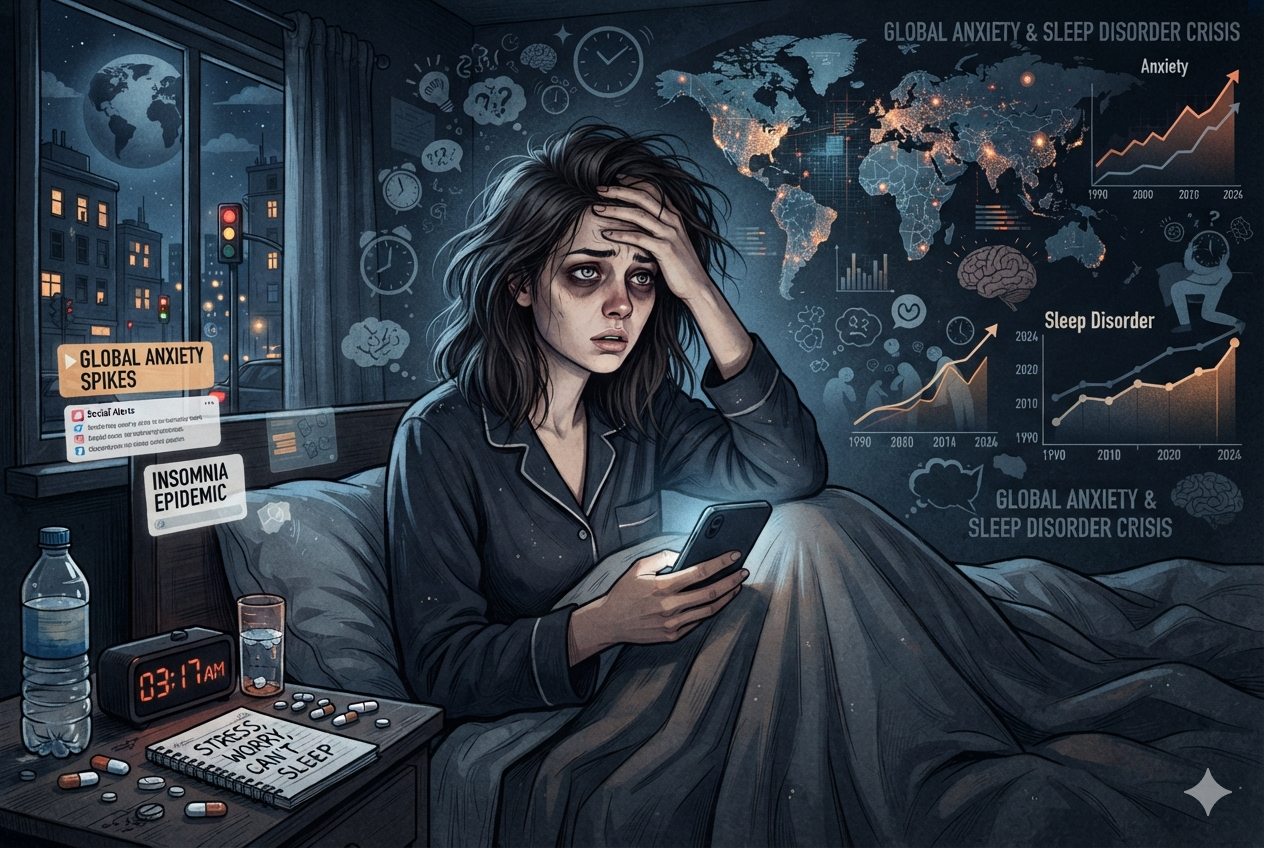
- The Chronicity of Insomnia: Data published by the Sleep Foundation indicates that up to two-thirds of adults face occasional insomnia, while 10% to 15% battle debilitating, chronic insomnia that persists for months.
- The Anxiety Spike: Global anxiety rates have climbed sharply over the last decade. The WHO fact sheets outline a spectrum of symptoms ranging from uncontrollable cognitive worry to physical tension and intense heart palpitations.
- The Gender Gap: Women are disproportionately impacted by this crisis. Research indicates that women are roughly 40% more likely to experience clinical insomnia than men, a reality further aggravated by hormonal fluctuations during perimenopause and postmenopause.
2. Why the Modern World is Built to Keep Us Awake
The Dopamine Trap and Screen Architecture
The Rise of “Revenge Bedtime Procrastination”
The Quantified Self and “Orthosomnia”
3. The Neurological Connection: How Anxiety and Sleep Destabilize the Brain
How Anxiety Halts Sleep
How Sleep Loss Drives Anxiety
4. A Comprehensive, Scientific Guide to Reclaiming Your Rest
| Intervention Strategy | Primary Mechanism | Targeted Metric |
|---|---|---|
| Cognitive Behavioral Therapy for Insomnia (CBT-I) | Retrains brain associations with the bed | Decreases Sleep Latency |
| Stimulus Control Therapy | Eliminates wakeful conditioning | Reduces Nighttime Awakenings |
| Digital Sundown Protocol | Protects natural melatonin synthesis | Increases Deep/REM Sleep |
| Somatic Down-Regulation | Deactivates the sympathetic nervous system | Lowers Cortisol Levels |
Step 1: Implement Strict Stimulus Control
- The 20-Minute Rule: If you are unable to fall asleep or return to sleep within roughly 20 minutes, get out of bed immediately.
- Change the Environment: Move to a dimly lit room and engage in a quiet, low-stimulation activity, such as reading a physical book or journaling.
- The Conditioned Response: Do not return to your bed until you feel physically sleepy. Keep the bed strictly reserved for sleep and intimacy—never use it for work, intense scrolling, or stressful problem-solving.
Step 2: Establish a Fixed Digital Sundown
- Disconnect Early: Power down all computers, work tablets, and primary smartphones at least 60 minutes before your target sleep time.
- Charging Logistics: Charge your primary devices completely outside of your bedroom. This entirely removes the midnight temptation to reach out and check notifications or scroll.
- Alternative Anchors: Replace late-night screen tracking with analog practices like gentle stretching, breathing exercises, or listening to low-frequency ambient audio.
Step 3: Utilize Somatic De-Escalation Techniques
- The 4-7-8 Breathing Method: Inhale deeply through your nose for 4 seconds, hold that breath for 7 seconds, and exhale slowly and completely through your mouth for 8 seconds. Repeating this cycle four times instantly stimulates the vagus nerve, lowering your heart rate and easing systemic physical tension.
- Progressive Muscle Relaxation (PMR): Systematically tense distinct muscle groups (such as your shoulders, forearms, or calves) for 5 seconds, and then release them completely. This physical release breaks the loop of anxiety-induced bodily tension.
5. Professional Intervention: When to Seek Medical Support
                             Do you experience:
                                      │
           ┌──────────────────────────┴──────────────────────────┐
           ▼                                                     ▼
  Symptoms for >3 Nights/Week                            Severe Panic Attacks,
     lasting over 3 Months                                Chest Pain, or Flashbacks
           │                                                     │
           ▼                                                     ▼
┌─────────────────────────────┐                       ┌─────────────────────────────┐
│   Consult a Sleep Specialist│                       │  Consult a Licensed Mental  │
│  for Evidence-Based CBT-I   │               │  Health Professional/M.D.   │
└─────────────────────────────┘                       └─────────────────────────────┘
- Sleep disturbances that occur at least three nights a week and persist for longer than three consecutive months.
- Sudden waking episodes marked by gasping for air, choking, or loud snoring, which can point directly to sleep apnea.
- Frequent, unpredictable daytime panic attacks, profound muscle tremors, or physical avoidance of regular daily tasks due to intense worry.
- Intense nocturnal panic attacks where you wake up suddenly with a racing heart, profuse sweating, and a powerful sense of dread.
Moving Forward: Reclaiming Your Right to Rest
- Are you finding it harder to fall asleep initially, or are you waking up in the middle of the night unable to get back to sleep?
- How many hours of screen time do you typically get in the two hours right before bed?
- Are you dealing with any specific physical symptoms like restless legs or gasping for air?
Dr. Lall Psychology & MindCare Services
Promotional Video : https://www.youtube.com/watch?v=T8OQ2YwKoe0
Quantum Psychology Experiential Program
Admission Form Available at : https://www.amazonauthor.in
YouTube Subscribe : https://www.youtube.com/@drlallpsychology
Linkedin Connect : https://www.linkedin.com/in/drlallpsychology
Linkedin Follow : https://www.linkedin.com/company/drlallpsychology
WhatsApp Channel : https://whatsapp.com/channel/0029VbDEEVb4o7qRCY6UEp38
To Buy Books – by – Dr. Solomon Lall 3-PhDs : Author, Mind Research Scientist, Grahastya YogRishi, Sr. Consultant : Emotional Health & Mental Wellness.
Most Popular, Acclaimed and Renowned Published Book, Now on Amazon book Stores throughout the world
Author Page : https://www.amazon.com/author/drlall
1) https://a.co/d/09tTuF6s : Quantum Psychology: Freedom from Painful Mind Matters
2) https://a.co/d/045dAL7q : Mental Hygiene is The New Dental Hygiene: The Science & Art of Keeping your Mind Clean
3) https://a.co/d/02a2WXGT : Menopause – The Mindful Pause: Redefining Menopause Through Mental Hygiene, Science, and Self-Discovery
4) https://a.co/d/01s1ae3A : Sanātan Psychology: The Science & Wisdom of Ancient Bhārata
5) https://a.co/d/0j3WmYTP : Quantum Biology: Healing the Mind With Secret Science
6) https://a.co/d/0dOByGYF : 1-3 : Quantum BioHack: The Secrets of Energy, Vibrations, Frequency & The Rhythmic Healing
7) https://a.co/d/0cPAiaQg : 2-3 : Quantum BioHack: The Secrets of Energy, Vibrations, Frequency & The Rhythmic Healing
8) https://a.co/d/0dnGlHR3 : 3-3 : Quantum BioHack: The Secrets of Energy, Vibrations, Frequency & The Rhythmic Healing
9) https://a.co/d/02XShiQh : Wired For JOY: A science-backed, heart-centered exploration of your happy hormones
10) https://a.co/d/05uD1fnf : Grahastya Yoga: The Supreme Yoga for Everyone
11) https://a.co/d/0eZn6yPF : Quantum Parenting: Parenting in the AI Age
12) https://a.co/d/03ybLa0Q : The CODD Problem : Cortisol Overload and Dopamine Deficiency.
13) https://a.co/d/00WOJjAr : Where is Your Mind Located: The Bhoot Blueprint
14) https://a.co/d/0hS1J6xK : Beyond Maya: Awakening the Mind’s Secret Science
For School & University Mental Wellness Partnerships :
For Schools – Download Flyer – (Very Popular) : https://drive.google.com/file/d/1qJ8uoDlHK7Pr0iXmID5oMFv-DkxbzV0H
For Campus – Campus Influencer Program –
https://drive.google.com/file/d/1UBFaSfoGQGBOg86G0uIgr4SUigg3n0pF
send Your Resume to mindlabs@authordrlall.com
To Check all Ongoing Job Opportunities. Study the Job Descriptions from our Associates Linked Posts :
: Social Media Content Creator – All over India. : https://www.linkedin.com/jobs/view/4435409715/
: University, School & Campus Influencer – All over India : https://www.linkedin.com/jobs/view/4433157584/
: Associate Psychologist – All over India.
https://www.linkedin.com/jobs/view/4436464924
Dr. Solomon Lall Psychology & MindCare Services is a premier emotional health and mental wellness practice delivering trusted, evidence-based psychological care. Led by Dr. Solomon Lall (23+ years experience, 2,500+ clients, 12,500+ therapy hours), the practice blends ancient Vedic mental body yogic concepts with modern mind sciences.
We provide holistic, tailored online services worldwide using a proprietary Quantum Psychology Blueprint and Quantum Biohack Framework. Specialized programs address emotional discovery, recovery, loneliness, pain, and age-specific mental health needs for individuals and corporates.
https://drlallpsychology.com
https://drsolomonlall.com
https://lalldr.com
https://whereismytherapy.com
https://leadpsychologist.com